Showing posts with label novels. Show all posts

Monday, September 15, 2014

Writer on Writer: Colleen McKee Interviews Sarah Shotland

For the latest Writer on Writer interview, I paired Colleen McKee and her book Nine Kinds of Wrong (JK Publishing, 2013) with Sarah Shotland and her new novel Junkette (White Gorilla Press, 2014). Today Colleen interviews Sarah about Junkette. Set in hurricane-season New Orleans just before Hurricane Katrina, Sarah's poetic novel Junkette follows the day-to-day of post-college bartender Claire and her addict friends, whose lives seem already underwater. Come back next week when Sarah interviews Colleen about Nine Kinds of Wrong. Colleen's unique book bears witness, haunts dive bars, and remembers long-lost lovers or cities through a combination of fiction, poetry, and memoir.

***** 

Colleen McKee: Writing a novel seems like a big and scary thing to do, especially a first novel. What compelled you to write this novel? How did this process start for you?

Sarah Shotland: I started writing Junkette in 2006, about a year after Hurricane Katrina. I was living in China and I didn’t know Mandarin well at all and I didn’t have many people to speak English with. One of the beautiful things about living in a place where I didn’t speak the language was that all the peripheral noise of advertisements, passing conversations, radio, television, billboards was silenced. I had the chance to really quiet the outside world and listen to what was happening in my own mind. And because I spent a lot of time alone, and in silence, I had a great need to communicate. So I wrote. And because I had a lot of time, I was able to write about 400 pages in the span of about nine months.

Colleen: People associate drugs with excitement and glamour. Claire is a sexy girl with a sexy job in a sexy town. Yet Junkette depicts some aspects of her life as being unglamorous: some passages are gross, and she complains at one point that the routines of being a junky are boring, that she’s hooked on rituals that are sometimes comforting but sometimes just dreary. How do you think about the poles of glamour/anti-glamour in this book?

Sarah: I think most of Claire’s life is unglamorous. From the very first page of the book, she’s trying to get out of town. She gets lice, she’s broke, at one point she vomits because she smells so bad. Addiction is an incredibly boring experience. It’s endless repetition. The chaos that surrounds addiction can sometimes be seen as excitement or adventure, but the realities of supporting an addiction are tedious, exhausting and demoralizing. I hope I didn’t glamorize any of that. But, I do think there are times when I romanticize or glamorize New Orleans. I was really missing New Orleans when I was writing the book, and I think that means there are times when I glossed over some of the city’s less glamorous realities.

Colleen: I had problems with drinking and coke in my youth, and like Claire, my circle of friends were bound together by drugs; most of these friends were men. It would be an understatement to say their intentions toward me were not always honorable. The same could be said of some male characters in Junkette, yet Claire doesn’t seem much to relate to the other women in her world. Would you like to say anything about the dynamics of power and gender in this novel?

Sarah: Claire’s surrounded by men. Part of my choice there was a reaction to Junky, by William S. Burroughs (and to a lot of drug literature). In the traditional drug narrative, a man is at the center of the story. Women are martyred wives and mothers whose lives are destroyed by the men who define them, or they’re temptresses and whores who lead men into self-destruction. I wanted to play with that dynamic and flip it a bit. I wanted Claire to be the center of the book’s universe without making the men into the same kind of flat characters women are sometimes turned into. I think Claire’s relationships with men are complicated. She can see that she’s giving away a lot of power, and yet she keeps engaging in these relationships. But she also makes really self-serving decisions. So men’s intentions towards Claire aren’t all honorable, but neither are hers.

Colleen: I like the title. It reminds me of Smurfette, in a sick funny way—just as Smurfette’s the only female in a world of men, Claire is somewhat isolated from other women as the main players in her life are male junkies. Of course the title also reminds me of Burroughs’ Junky. Would you like to say anything about the title?

Sarah: I love Smurfette, and I love thinking of Claire as a tiny blue creature! And yes, I was definitely playing on Burroughs with my title.

Colleen: Do you think addiction fiction or addiction novels are their own kind of genre or tradition? This could be a lens through which people read Junkette. How do you feel about that?

Sarah: Definitely, and I hope people who love reading addiction novels will find Junkette.

Colleen: New Orleans is in itself a powerful character in this novel. Why did you choose to set Junkette there?

Sarah: When I started writing the book, I’d just moved away from New Orleans. I don’t feel like it could be set anywhere else. I was also really frustrated with New Orleans constantly being defined by Katrina, so I wanted to write a book that was set pre-Katrina. I tried to include as many places that no longer exist post-Katrina, and really paint a picture of a particular time in the city.

Colleen: Many novels about young women are coming of age stories, and they follow the traditional narrative arc of the Bildungsroman (literally, “a novel of building character”). The Bildungsroman shows how the female character’s childhood affects her young adulthood, and after going through some crisis or challenge--which is resolved by the end of the book-- the character has passed through the frightening transition from girl to woman and she’s clearly reached the other side. But this novel is very focused on Claire’s present life and her immediate future. How did you make the decision to not include much about Claire’s upbringing, or even her recent past?

Sarah: Addiction is really complicated, and I think too often it’s presented as being caused by something. A traumatic childhood, a destructive relationship, poverty. I wasn’t that interested in exploring why Claire is an addict. I was just interested in how she experienced it. Because the book is written in first-person, I didn’t think Claire would reflect that much on her own past; she’s caught in a very present-moment experience that means she can only really respond to the immediate problem she’s facing. I felt having her reflect a lot would be inauthentic and move into some dangerous territory of trying to explain away her choices.

Colleen: Junkette’s structure also resists tradition. You use often very short sections, definitively broken with typographical symbols. To me, this results in an intriguing sense of time being fragmented, highlighting this moment, then this moment. Do you see it this way? How did you decide on this form?

Sarah: As I was writing Junkette, I read Mary Robison’s books One D.O.A., One on the Way; Subtraction; and Why Did I Ever. Robison uses really short sections—she says she writes her novels on individual index cards. I really fell in love with her work. As soon as I read her, I knew Junkette had to be written in tiny sections.

Colleen: Claire makes a lot of lists. Some are poetic, some funny, and they are interspersed throughout the book in an intriguing way. Would you like to say anything about the list form and how you use it in Junkette?

Sarah: I think Claire’s really seeking order. Her addiction is a way of ordering her life. Her lists are a way of ordering her life. I secretly want to be a poet, but sadly, I am very bad at writing poetry. Lists are about as close as I come.

Colleen: What moved you to co-found Words without Walls (which, to use your words, “brings creative writing classes to jails and rehab centers in Pittsburgh, PA”)? Would you like to say anything about these students?

Sarah: I’m motivated by a lot of factors in my work with Words Without Walls. We have a huge problem with locking people up in this country. I’m not a lawyer or a politician or a social worker. I would be very bad at all those things. I’m a writer, so I try to do things with writing that address problems in our society. My students in jail and prison are just like all my other writing students: some are incredible writers, some aren’t that great, some don’t care at all about publication, some want an audience. But I think the act of writing is useful for everyone. Writing allows for reflection, reimagining, empathy, self-expression, spiritual engagement, fantasy, escape from and engagement with your self and your circumstances. The feedback I get from my students in Words Without Walls ranges from Writing changed my life and I’ll never be the same, to It was a relief to have a class every week that got me off the housing unit. I consider both and everything in between to be a success. What is somewhat different from my other students is an inability to deal with writerly bullshit. They aren’t at all interested in the professionalization of creative writing and the nonsense that comes with it. That means I have to bring in only the very best writing I can find, the most necessary pieces, and that brings me a lot of joy.

Colleen: You also work with students in the MFA program at Chatham University. This seems like it could be a very different experience than working with students in jails and rehab centers. How would you compare working with these two sets of students? In what ways are they similar, and in what ways are they different?

Sarah: I really enjoy teaching in both environments. I also work with kids, which is another variation on teaching. I’d say working in a university, I really get to geek out on the minutia of writing. People can get a lot of pleasure and meaning out of an hour long discussion on point of view in an MFA class. With kids, I get to do a lot of creative, imaginative exercises and I get to see huge improvement in a really short amount of time. In all my classes, my favorite part of teaching is bringing in a story I love and seeing students discover it for the first time. I will never forget the teacher who introduced me to Margaret Atwood and Joan Didion. When I get to teach those writers, I feel really honored to be part of that ripple effect. With my students at jails and prisons, I get to remember why I started writing in the first place—to make sense of my self. I think the mixture of the environments is why I can stay enthusiastic about teaching. I get to meet lots of different people, and I feel really lucky that my jobs all entail reading and writing and talking about reading and writing. It’s a pretty wonderful thing to do for work.

Colleen: You’ve worked in theatre. Sometimes novelist/playwrights’ novels feel a lot like theatre—heavy on dialogue, light on introversion. Junkette doesn’t feel theatrical, though. Do you feel like writing plays has influenced your fiction writing and vice versa, or do they feel like two very different worlds?

Sarah: I think writing for the theater has helped me with plot. In the theater, everything is scene. If nothing happens, there’s no play. So that’s really helpful to me as I write fiction, because in prose, I naturally tend to write a lot of introspective reflection, which can end up moving very slowly. I love writing for the theater because playwrights really have to give their work away to other artists, and then we get to watch it become itself. In fiction, the writer ultimately has a lot more control of the final product. But I will say that I tend to write a lot of monologue in my plays, so first-person fiction isn’t too far a stretch from that.

Colleen: Who and/or what are your biggest literary influences?

Sarah: Here’s my literary dinner party: Joan Didion, Anne Sexton, Margaret Atwood, Toni Morrison, Maria Irene Fornes, Sarah Kane, Mary Robison, Kate Chopin, Jean Rhys, Lydia Davis, Claudia Rankine, bell hooks. I also love Kenneth Patchen, Etheridge Knight and Walt Whitman (I don’t want to leave out the dudes.) At our dinner party, we’d drink cheap beer and fancy whiskey and I’d make tacos.

*****

Don't miss the next installment, due approximately Monday, September 22: Sarah Shotland interviews Colleen McKee about Nine Kinds of Wrong.

Find Junkette at White Gorilla Press here:
http://whitegorillapress.com/ 

Find Nine Kinds of Wrong here:
http://ninekindsofwrong.blogspot.com/

Click the Writer on Writer tag to read past interviews in this series.

Friday, March 14, 2014

Writer on Writer: Part Two, Bradley Spinelli Interviews Daniel McCloskey

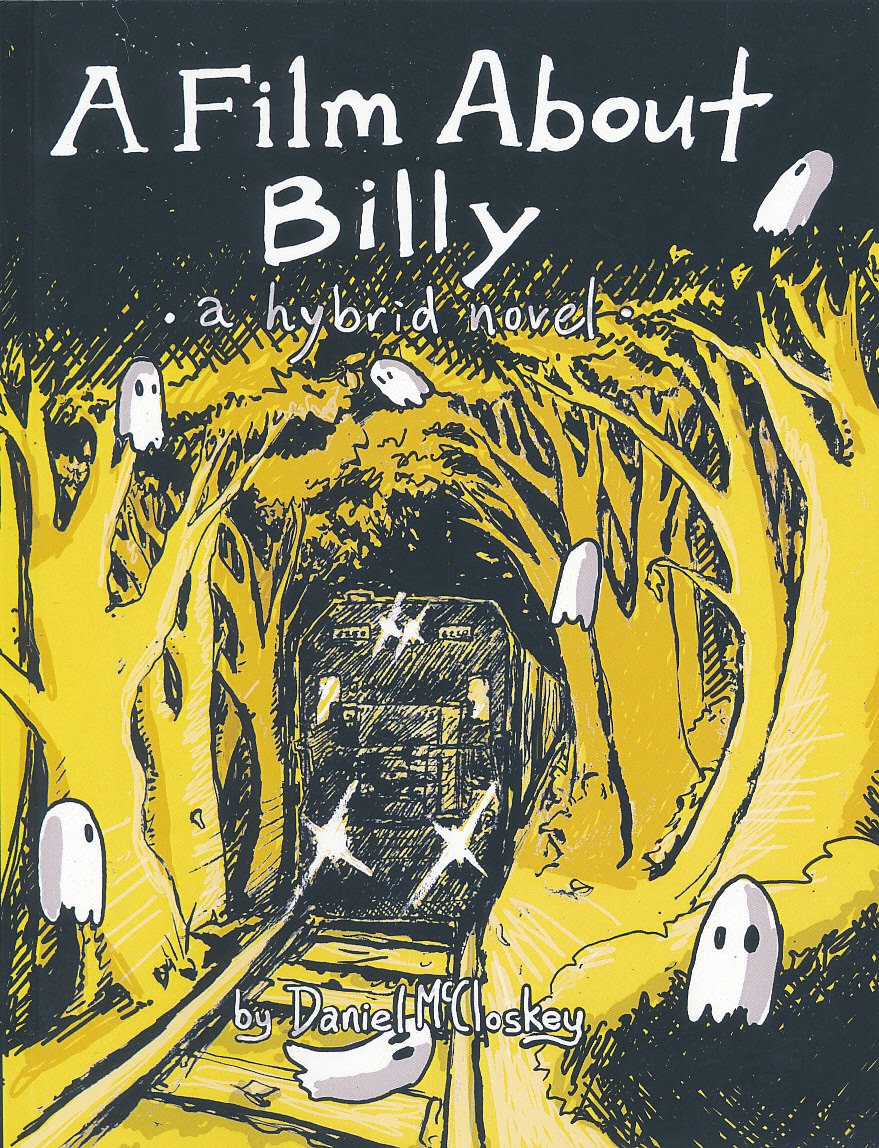
Following up on the last Writer on Writer interview, this week Bradley Spinelli interviews Daniel McCloskey. Bradley is author of Killing Williamsburg (Le Chat Noir) and Daniel wrote A Film About Billy (Six Gallery Press). Each 2013 novel follows a protagonist trying to outlive a suicide epidemic. At my suggestion, Bradley and Daniel read each other's books and came up with their own questions.

*****

Bradley Spinelli: I have to ask the obvious. Why a suicide epidemic?

Daniel McCloskey: At first it was in response to tragedy. I was 19. I heard, months after the fact, my friend had killed herself. She was the second friend of mine in two years to take their own life. Both did it before they turned 18. At the time I was dating someone that had been suicidal, and a number of people I knew had attempted or talked about it seriously. I wrote about a suicide epidemic because I thought there was one, and as it turns out there kind of is one. In Stephen Petranek’s TED talk, 10 Ways the World Could End Quickly, a depression epidemic makes the cut.

I also think apocalypse via suicide builds a dramatic image of the simple truth that we all die. While any apocalypse narrative has mass deaths, a suicide epidemic seemed to keep the focus on individuals and their deaths instead of the lava, the rain, the whatever that a protagonist might work against. The people that hurt you in a suicide epidemic are the victims, and they are already gone.

Bradley: I just read Malcolm Gladwell’s The Tipping Point last year. He talks about the teen suicide epidemic in Micronesia in the early ’80s.  Did you know about that or did it have any influence?

Daniel: Yeah, I ran into The Tipping Point while I was studying abroad in Japan in 2007. That was also when I started putting comics into my book in earnest. Takashi Murakami’s Little Boy was a big deal for me at the time as well, the essays more than the art. I wasn’t sleeping a lot then--just walking around dark lonely Tokyo streets at night, and doing a lot of research in my University's English language library during the day.

Bradley: In your book the media pushes the epidemic, both in using the term “pandemic” to increase ratings and the very real idea that the media can spread the disease, that suicide can be just another meme. In writing Killing Williamsburg, I was taken by the fact that the New York Times doesn’t run stories on suicide. What’s your feeling? Should the media report suicides?

Daniel: I think what happens when a story about suicide is in the paper is that it opens up that possibility for people. It’s kind the opposite of, “If you can dream it you can be it.” It’s more like, “If you can’t imagine it you can’t do it.” So for someone who is predisposed towards suicide at the moment they see a suicide in the paper, suicide becomes an option in a concrete way. Yet suicide is no less the decision of the person who read about it in the paper than it is of the person written about in that article.

I tend to think we need to respect people’s ability to make decisions, even if we as individuals don’t really know why we do things. Do you know what I mean? Have you ever been in an argument with someone who’s hungry, and you know their anger has almost nothing to do with whatever your talking and has everything to do with a lack of food? I feel like in that case you need to respect that person’s feelings because those feelings are real, but we also need to address the underlying issue: hunger.

If suicides propagate every time a suicide is in the paper, I tend to believe that the problem isn’t the publicity but a deeper untreated depression issue that is illustrated by the fact that there are people walking around ready to off themselves once the thought occurs to them.

In Mexico, for example, suicide is publicized all the time in graphic detail, often with photographs, and the suicide rate in Mexico is less than half of the USA’s rate.

So, should the media report suicides? I don’t know.

As an author trying to orchestrate a suicide epidemic in your fictional world it seems that it would make the most sense to have the media ignore it while it begins, allowing the problem to snowball on its own in a localized environment (like in your book), then have the media pick it up when the suicides are at their peak. Because I do think that an environment where suicide becomes the norm might make it difficult to imagine the possibility of not killing yourself, especially for the young and impressionable. New York would be a great location to begin an American epidemic because the residents are from all over and have emotional connections to so many communities. There’s probably someone who loves someone in NYC in every corner of the planet.

Bradley: You describe A Film About Billy as a “hybrid novel”—half novel, half graphic novel. Did you ever consider doing the entire book as a graphic novel?

Daniel: When I began A Film About Billy the story was partially in screenplay format, but that format ultimately didn’t work for what I wanted to do. I learned to draw comics in order to make this book work, but I’ve always thought of it as primarily a prose novel. I am working on a comic series right now, Top of the Line, a monster fighting comic about a kid growing into a hero and in the process a terrible bigot. I’m enjoying that immensely, but I plan on going back to the hybrid format. Prose does something really different than comics and vice versa. As a story teller and an artist I get excited about the sheer unexplored possibility in comic prose hybrid work. Hopefully I’ll be announcing a new hybrid project in the summer.

Bradley: The book is paced really well. At the beginning, the present story is written and the past, which was videotaped, is drawn. This evolves, so that other segments of the story are drawn as the plotlines begin to diversify. How carefully did you plan what would be drawn and what would be written?

Daniel: To start, I just knew I wanted to use comics for the video tape “flashbacks,” but there were a couple of rules that worked themselves out for me really quickly. First, I didn’t want too many comic pages. I thought it was important to feel that the comics were speeding up the pace of a novel, instead of having a lot of text bogging down a comic. The prose is first person, so anything that I wanted to include in the story that Collin couldn’t see had to be in comic format. I also liked the idea of having more comics near the end of the story to add speed and intensity to the climax, so I added a page or two that could have been prose based on the other rules. That’s it. Basically I wrote and drew it together, so other versions had different comics as well as different text.

Bradley: The book starts out very naturalistic and becomes increasingly strange. The first mention of “weirdness” is experienced by Billy when he’s on shrooms, so we’re encouraged to dismiss it. But as the story becomes more fantastic your drawings also dabble in more dreamlike imagery. (You also introduce a talking Mr. Coffee.) How much of this book is intended to work on a subconscious level?

Daniel: I think that’s the whole ticket in fiction. We synthesize information into an emotional language so that our old monkey brains can digest it. Jung would talk about it as more of a bridge between the conscious and the subconscious, but it’s the same general idea. I think a lot of good fiction operates on a subconscious level without any weirdness, but that weirdness is what makes me me. I like to talk about serious issues through goat-eyed tigers, fighting robots, and talking coffee pots. I love Richard Brautigan and Dragon Ball Z, what can I say?

Bradley: Early on, all the gore happens off-screen, starting with Billy’s suicide and the great line, “When we learned what a train actually does to a body.” Even as the epidemic spreads, we only see a few suicides actually happen. It’s interesting to me, since I went so up-close and graphic in my book. How/why did you make this decision?

Daniel: I think that Collin didn’t really like thinking about how his friend died, even though that’s all he ever thought about. There were a lot of things he didn’t like thinking or talking about directly throughout the story. I tend to agree with a certain brand of literary artist who believes that the most powerful parts of a story are the parts that are unsaid, and having the deaths occur largely off screen gave them a certain weight in my mind.

Bradley: Overall, your book is much more concerned with male relationships—fathers and sons, and the brotherhood of friendship—than it is with women. But there are also buried details that suggest Billy was gay or bisexual. Why didn’t you investigate that further?

Daniel: That again was an issue of Collin not wanting to think (let alone openly talk) about his dead friend’s sexuality. I think that Collin has a real (and maybe accurate) impression that the omnipresent homophobic language and attitudes hurt his friend and contributed in some part to his eventual demise. Also, as an author I don’t give up much information about Billy at all. He is always there, but never fleshed out as a character. He is a ghost.

Bradley: Early on, Dan brought Billy back to life, so to speak, through the video for his funeral, yet Collin starts over. It’s obvious that you, as a writer, wanted to bring someone back to life in writing this book. Do you think it’s possible? Or did it at least help your own process of mourning, paying tribute, and moving on?

Daniel: You can’t bring someone back to life. You can’t even keep anyone alive. Everyone you know will die, and you will die. Again, that is the basic truth revealed in a suicide apocalypse.

Though I think there are certain truths humans will never stop needing to hear. We will die, love matters, greed kills, hubris makes and breaks our heroes, other people are whole other people, etc, etc. That’s why the one funeral in your book is so touching. You aren't burying “remains” when you bury your friend. You bury part of yourself. You’re giving your idea of them a place to go.

Bradley: The antagonists talk about gamma sync, and a cure for depression. I know gamma waves are often identified with mood and have also been discussed in relation to the binding problem. The theory that gamma waves can link information from all parts of the brain is a nice metaphor for the interconnectedness of the world that becomes a nightmare in your book. How invested were you in the science of the gamma profiling?

Daniel: I’m not very invested to be honest. Gamma sync was mostly a practical device for the sci-fi engine of the book, but I do think that mood and subtle mannerisms in our emotions may be the personhood that brings all our memories together. Even if you could download all the knowledge/memories in a brain you probably wouldn’t have that person without gluing a demeanor to it. I wanted these scientists to be working on something that they didn’t understand completely. The back story I constructed (but did not include) for the machine made gamma waves a plausible and potentially finicky element of the operation.

Bradley: The parallels between our books are downright eerie. Some stuff you just know, like that the National Guard would get involved. But in both our books the protagonist makes an appearance on TV—and don’t get me started on your book’s being titled after the character “Billy,” and mine after the neighborhood of Williamsburg, which is often called Billburg or Billyburg. (Shudder.) The part that made me jump up was when, after witnessing a suicide, Sarah tells Collin, “You’re not human.” I have virtually the same scene in my book when the protagonist is accosted by his girlfriend for being so cold. My wife likes to say that Benson is prepared for the suicide epidemic because he’s such an asshole, that thick skin is necessary in extreme conditions. What do you think?

Daniel: The TV thing is kind of a simple device to allow your character to give a speech, like right before battle in a war movie. It gives your character a moment to summarize the situation in their understanding, and show their true colors when the pressure’s on. I liked that part of your book. It was fun.

Maybe if there was a suicide epidemic a lot of people would accuse each other of not being human, or maybe it was again a good way for us as authors to say to our respective audiences, “Our character is different. Our character is alienated from the mainstream,” which we needed to say to make our characters largely ineligible for suicide. I for one didn’t want my readers to be wondering whether Collin would kill himself or not the whole time. I just didn’t want the story to be about that.

I had the same impression as your wife had about Benson. Collin isn’t as tough as Benson though. He’s alienated, and continues to alienate himself as a form of protection. He does his best not to get close to anyone in order to avoid being hurt by their eventual death. The problem, of course, is that Collin can’t help but care about his friends. That is why Mr. Coffee is so important. He’s the one friend Collin knows will never commit suicide. He’s a coffee pot, it’s just not possible for him to do anything, let alone kill himself.

Bradley: Both of our books feature a character telling another the simple answer: “Don’t kill yourself.” Do you think it’s really that simple?

Daniel: Well, no. I think suicide is really really complicated. But, at the same time I think that might be the right thing to say when you’re knee deep in a suicide epidemic. When Collin says something like that to Tyler in my book he’s empowering the kid who doesn’t feel like there are any options for him. To refer back to the question of publicizing suicide in the media--in a world where everyone is killing themselves a pre-teen with nobody left might not see any other options. Collin slapping Tyler on the back saying that he could make a point of being the last living person and stopping the epidemic hell or high water might just have been enough to save him. He could be the one, he could build tree forts on the top of the Empire State and howl at the moon. Ride horses through Disney Land... whatever. He’s just opening options in somebody else’s mind. I’m not saying, “If you can dream it, you can be it,” more like, “If you can’t even imagine it, you probably won’t find your way there.”

On the other hand at the very end Collin is being kind of a dick. He’s not even trying to find a cure, and maybe he could. He feels attacked by those who have killed themselves, and after all he was just killed by these people asking him questions. Saying “don’t kill yourself” in that context is kind of saying “fuck you.”

*****

Find A Film About Billy here

Don't miss Part One of this Writer on Writer: Daniel McCloskey Interviews Bradley Spinelli

Ealier in the Writer on Writer series:

Dave Newman Interviews Alex Kudera

Alex Kudera Interviews Dave Newman

Thursday, February 27, 2014

Writer on Writer: Daniel McCloskey Interviews Bradley Spinelli

Writer on Writer is a new interview series where I ask two small press writers to read each others' books and come up with interview questions for each other. In this second pairing of the series, I asked authors Daniel McCloskey (Pittsburgh) and Bradley Spinelli (Brooklyn) to participate. The latest novel by each author features a protagonist who finds himself enduring a suicide epidemic. McCloskey's novel, A Film About Billy (Six Gallery Press, 2013) follows Collin, a 17-year old trying to make sense (and a documentary) of his late friend, Billy; Spinelli's Killing Williamsburg (Le Chat Noir, 2013) is set in 1999 and narrated by a Gen-Xer, Benson, who has recently moved to newly-hip North Brooklyn.

As with the first pairing (Alex Kudera and Dave Newman), I am posting the resulting interviews in two parts. Stay tuned for Part II: Bradley's interview of Daniel, which I hope to post within the week. Please enjoy Daniel McCloskey interviewing Bradley Spinelli about Killing Williamsburg.


*****   


Daniel McCloskey: Killing Williamsburg is about New York in so many ways. You describe the ins and outs of Williamsburg, the character of surrounding neighborhoods, as well as the history of Hart’s Island and through it the city’s relationship with death. The narrator, Benson, mentions the difficulty in scraping out an identity in a place where it’s impossible to ignore that there are 6,000 people just like you, and in the beginning of the book many of those 6,000 are close at hand. He is surrounded by other struggling creatives who are relatively new to the neighborhood. His friends, his neighbors, the people he likes and dislikes that fill the many bars he occupies all share a particular demographic. By the end of this novel Benson’s community is a kind of cross-cultural sample of NYC. In order to clean up the mess left behind by the epidemic, Benson is working side by side with Poles and Mexicans, hipsters and yuppies, friends with working class or service industry backgrounds, and even a “suit” from the uppity offices of Manhattan.

Is Benson living the myth of New York at the end of this book? The beautiful melting pot? Do glimpses into the empty apartments of all these different kinds of people make him feel closer to them or is this just a case of differences falling away in the face of adversity? Could you talk about the separation of different communities in your city?

Bradley Spinelli: In New York, communities are separate but also right on top of each other. I think “melting pot” is a little off—it’s more of a stew, because people retain their own cultural norms while getting seasoned by others. Fifteen years ago, Williamsburg was a very different neighborhood, and I learned a few words of Polish just so that the ladies at the bakery would be nicer to me. I think that the divisions are more based on class and finance than race or ethnic background, but even so, you always have the option of engaging with people in other worlds. There are so many people in such a small space, and any time you’re in public there is a chance for lines to cross. A lot of New Yorkers have changed careers, or lived in other places, so it’s surprisingly easy to find things in common with people who—at first blush—may seem very different from you. In Benson’s case, I would argue for differences fading in the face of adversity. It’s something we saw in New York on September 11th, and again with the blackout, Hurricanes Irene and Sandy. Differences do fade very quickly in emergency situations, and that’s an intense binary flip in New York considering our necessarily thick skins. You can’t be too sensitive to the people around you, day to day, when there are so many of them. We can be very distant in our own private worlds, but if, say, a subway line goes down, people will immediately share cabs with total strangers.

Daniel: One of the major turning points in your novel is when the deaths spread to Manhattan. A place where Benson escapes from his personal problems and drowns himself in work, sleeplessness, weed, and cocaine. Can you talk about why this was so hard for Benson? Is it because Manhattan became his personal sanctuary, or because the money and glamour that epitomizes a certain New York fantasy seemed to be enough to ensure the desire to live? Does it show the ultimate hopelessness of his current mission to stack paper and get ahead if the people that are “ahead” don’t seem to be any better off?

Bradley: Back in 1999, Williamsburg seemed very far away from Manhattan. Yellow cabs would routinely refuse to take me home—now you can hail a yellow cab in Billburg. Back then, a lot of my friends lived in Manhattan and would never “cross the bridge.” Remember what a big deal it was when the redhead on “Sex in the City” moved to Brooklyn? That was 2004. There was a much firmer division back then.

For Benson, it was an escape to shift his focus to Manhattan, especially after so many of his local friends were gone. And he certainly got sucked into the Manhattan cult—money and status, sure, but also the device of sex and drugs as pure escapism. It was a hopeless mission, because the epidemic couldn’t be ignored. He felt it was chasing him.

I don’t think Benson was ever really concerned about committing suicide himself. He fought his own demons, fought the effects of the epidemic, but… I was never worried about him. Not like that.

Daniel: In a way, your main character becomes the king of New York, or at least the top dog of Williamsburg. He becomes so known and respected that his identity is solidified. He is not one of 6,000, he is Benson the crew chief of Los Hombres--a somebody among somebodies. Do you think this is another one of the big New York dreams? Is this Benson’s reward for sticking it out?

Bradley: No question—the New York dream includes recognition. Having “juice”—the kind of power that comes from notoriety, a currency that’s better than money. Benson achieves a degree of this, but it would be a stretch to call it a reward. He suffers through some serious shit, and he’ll be forgotten soon enough. It’s noteworthy that he turns down more glamorous job offers in the “New” New York. He’s looking for normalcy, not glory.

Daniel: Picking a main character in a suicide epidemic is a tricky business. You want to build a character that can survive long enough to illustrate the larger narrative. You and I both seemed to have the epidemic in our books travel in a kind of social way, that is to say it wasn’t like 28 Days Later where transfer of rage was via bite. Transfer of “the bug” was a little less obvious. Overwhelming sorrow, trauma, and the availability of an “exit” (like in real world suicides) seemed to be the triggers. Benson, I don’t think it’s rude to say, is a bit of a jag in the beginning of this story. Is his cold ass-holedom a kind of superpower which allows him to survive long enough to discover his talent for hard work and pragmatic thinking? Do you feel like the world needs some cold ass-holes out there? Were you concerned about alienating readers in the early chapters as you established this particular characteristic in your protagonist?

Bradley: Benson’s kind of an asshole. It’s true, and I make no bones about it. My wife says that Benson’s—er, harshness? coldness?—makes him not only capable of surviving the epidemic, but capable of doing the dirty work of cleaning up the town. Yes, the world needs some cold assholes. Take our military, and the kids who come back from the Middle East after being trained and hardened, and how difficult it is for them to integrate back into society. Benson becomes a soldier, and a good one, because he was predisposed to a kind of detachment that is generally considered a hindrance in polite society. I recently read a fascinating book, On Killing by Dave Grossman, about humans’ basic resistance to killing and how armies have developed methods to overcome it.

I didn’t worry so much about alienating readers—with the graphic violence, sex, and drugs in that book, there’s plenty to put people off. But I held tight to Benson’s character. I felt there was enough humor that some readers would enjoy his callousness, and some would be pulled along in spite of it, either because of the other characters, or because of the natural love-hate magnetism of assholes. It’s important to the story I wanted to tell—if he’s a nice guy at the beginning, where’s the catharsis?

Daniel: This novel is particularly good at describing work dynamics. Your character comes out of his shell amongst co-workers in a way he doesn’t for friends or lovers. Perhaps because he feels safe or invincible in the coked out semi-paradise of Manhattan. How do you think the value of work is integral to your character and his development? How do you construct work environments as an author? Do you draw off personal experience or do you grab a bunch of characters, put them all on the same team, and see what happens?

Bradley: The value of hard work, of rolling up his sleeves and getting dirty, is important to Benson. He doesn’t deal well with idleness. Thinking got him nowhere, work was a kind of salvation. Ultimately, he had to do something because doing nothing was torture. This is very different from someone with more altruistic motives. It starts with personal survival.

I worked as a stagehand and lighting technician in New York. It was my introduction to a world where people easily spend 250 thousand dollars on a wedding or a bar mitzvah. I worked a bat mitzvah that cost over a million dollars, and that was almost ten years ago. The dancing girls and dancing boys in the novel—that’s a real thing. Young, good-looking men or women are hired to spice up the dance floor. It’s nuts. So I had a sense of the social dynamics in the techie world, and I liked the idea of using those kinds of skills to run a crew cleaning up dead bodies. It translates well: loading trucks, carrying heavy stuff. Not a lot of sleep. And then it’s wide open—you can recruit any kind of character you want.

Daniel: I know the release party was also an awareness event for World Suicide Prevention Day. Were there survivors of suicide at the release? How did you navigate the many graphic sections of this story in that social environment? Do you know anyone who has committed suicide?

Bradley: It was important to me to have the release party on World Suicide Prevention Day. The book has some very dark humor, but I wanted to go on the record as being anti-suicide. We got a lot of press because of DJ Questlove, and while I was concerned that people would find my “Suicide Set” idea morbid, I wanted to illustrate just how common suicide really is. Certainly I had some survivors at the event—both people who had lost loved ones and people who had attempted suicide themselves. I toasted to some people that I’ve lost. I lost a former scoutmaster, who became a friend and advisor when I was a teenager. And I lost two people in recent years who were in that gray area—drug abuse, and that questionable thing of was it on purpose or was it not. Which is not really much of a distinction. I quote this every chance I get: suicide is the 10th leading cause of death in the United States. Homicide is sixteen. (2010 data.)

Daniel: The point of view changes in three chapters of this book that really stand out due to technical authorial decisions: “Coney Island” p. 113 is a kind of unmarked flashback, the following chapter “Listless” is in 3rd person, and “Cold” p.142 is in 2nd person. The writing dork in me is curious about these decisions, especially the 3rd person section. Is “he” Benson, not himself, as close as he ever got to killing himself while in a past life daydream?

Bradley: In early drafts, I experimented with methods of documenting Benson’s struggles with alienation and self-loathing. Later, the book changed a lot through cuts and restructuring—like shuffling a deck. “Coney Island” was originally told in sequence, but I thought it worked better as flashback—a sun-streaked, summertime almost-dream-sequence. “Listless” and “Cold” are about how you talk to yourself, especially in times of duress. Sometimes you address yourself directly—the second person—and sometimes you feel like things are happening to you as a third-person character. You can almost see it happening to you at a great remove.

In “Listless,” I like how the third person winds down the second section and bridges into the second half of the book, when everything gets really heavy. It gives the reader a chance to get out of Benson’s head and watch him wander into the post-apocalyptic landscape. I don’t know if that’s as close as Benson came to killing himself, but it’s certainly the farthest he ever got from himself. And that’s key. Once he gets completely out of himself, he’s able to pursue something bigger than himself. It’s almost like finding religion.

Daniel: Where is the best place to buy Killing Williamsburg

In New York, the best place is Spoonbill and Sugartown on Bedford Avenue in the heart of Williamsburg. If you're outside of New York, check my website http://killingwilliamsburg.com/ for other options.

Daniel: What are you working on now?

Bradley: I'm working on a novel set half in Brooklyn and half in Bangkok. I've been to Thailand many times, and researched this book through two different month-long residencies in Bangkok. I've finally completed a first draft which means I have my work cut out for me. I'm also working on another screenplay—I've written several—that's been percolating for some time.

Daniel: Where will I find your new work on the internet?

Bradley: Recent stuff is an essay I wrote for Frontier Psychiatrist, and I also have a piece coming out soon for Mandy Boles. She asked me to write about "my first favorite book," so for anyone who read Killing Williamsburg, this will be something different.

*****

Stay tuned for "Part Two: Bradley Spinelli interviews Daniel McCloskey."

Find Killing Williamsburg here.

Ealier in the Writer on Writer series:

Dave Newman Interviews Alex Kudera

Alex Kudera Interviews Dave Newman

Saturday, January 25, 2014

Guest Review: Zarina Zabrisky by Polly Trope

Zarina Zabrisky, We, Monsters. San Rafael, Ca.: Numina Press, 2014. Novel. 316 pages. ISBN: 978-0-9842600-4-1

We, Monsters offers reader entertainment with both light and heavy topics – there be dungeons and dominatrices, manicure studios, the emotional frustrations of a housewife in American suburbia, spies in Odessa hotels, Vogue-smoking women in stilettos, a broken childhood, and the dream of an ice cream van, just to name a few examples. As a novel, it ties together beautifully the very flighty feelings and observations of fugitive moments--a reflection in a glass here one moment and gone the next--with the heavier, less digestible feelings and memories that can plague someone for a lifetime.

"I couldn’t unglue my eyes from the puddle. It was quivering, and the eggshell walls of my living room jiggled. My wedding photo and the rainbow-hued vase trembled and blurred. This is how my lost time always started."

As a special extra, the hip meta-twist, this novel provides in fact not only itself, but also a comprehensive set of footnotes and comment apparatus in the voice of a psychologist putting name tags to all the feelings and behaviors that readers will be shown. As it happens, it’s also a conversation with a psychologist that forms the center point of the book, neatly parting the novel into two halves. Those two halves of the book are complementary to each other but actually very different, so that readers are getting almost a double bill.

In the first half, we see a young-ish woman – approaching middle age, but not quite there yet – in the suburbs of San Francisco. She’s a dedicated wife, mother, and domestic goddess, and she starts letting "us" into her life as she is toying with the idea of working as a dominatrix, at the starting point of writing a novel on the subject. She shares with her reader, then, her preparations: how she gets herself one sexy outfit, phones up for the job interview from a gas station payphone, drives off to her first job in a dungeon, works under a grotesque man-woman character of a madam and alongside meaty other ladies, etc.

"Fat caterpillar eyebrows crawled up. Beady eyes drilled through me. After a long moment, the mustached upper lip twitched into a grin. A long hair sticking out from the mole on the side of the hooked nose trembled, and Margaret said, in the hoarse bass of a retired sailor: 'Come on in, doll.' "

Then we move on to girls, clients, and the torture garden madness. All along, the narrative female voice strews little hints and shadows of her childhood and youth, chapters of her life that she has left behind her, in Odessa.

In the second half of the novel, here we are at last, in Odessa with the seventeen-year-old self of that same now-mature woman who was just writing about dropping her children off at school in the suburbs of San Francisco. The Odessa part of the story moves backwards from the moment when the narrator’s beloved sister, Oksana, is turned into a prostitute by an army general, setting her up in a swanky apartment smack in the middle of town, covering her in diamonds and designer clothes.

"He fed her chicken Kiev and poured her sparkling sour champagne, and she never stopped laughing. In three weeks he rented a four-bedroom apartment for her—antique chairs with lion paws, crystal chandeliers and midnight-blue velvet curtains—right on Deribasovskaya. My grandmother marched there to claim Oksana, and I followed her, hiding behind taxicabs and chestnut trees. I would never forget her face on that day. Grandma Rosa never cried, not at her husband’s funeral, not at her daughter’s funeral (...)."

Like a sea receding at low tide, the story here (in between present tense scenes in the dungeon and suburbia) moves back and back, to more and more distant childhood memories, that are as painful to the narrator as they are narrated in crystal-clear detail, whilst, at the same time, they are presented in such a phosphorescent, glassy, iridescent light, that they elude grasp.

"When I was little, the world had colors. My past burst with the bloody red of cherries, the rainbow brightness of beach umbrellas. It was smudged with the jet black of Grandma’s pumps or Oksana’s mascara. It was 3-D (...)."

Here, the architectural design of the steps in Odessa, the famous stair built in such a way as to convey the optical illusion of infinity, becomes the vehicle of the wish to believe that the mother’s suicide at three years old was not real. Here, the adored older sister is seen selling pistachio ice cream on the beach, even if, as the close reader will observe, there was no pistachio ice cream in the Soviet Union.

The novel is rich in imagery and tropes, in particular those related to delicate colors, rainbows and iridescent patterns, which not only prettify the flow of the read and introduce a glittery sprinkle of magic in the style of the old Russian novels, ballets, and fairy tale cultural patrimony. These images looming in the background of the story also become symbolic dots that readers can connect in order to better understand the person telling the story, and to look inside the thinking and viewpoint of the narrator-character: this woman whose life is torn in half, whose new life is nothing like the old, and yet, is very much the same: all too much the same.

"I thought about Vickie, Vanessa’s sister, and imagined her climbing the railing, imagined being her: dizzy, out of breath, as if I were about to give a public speech—in English. Like Vickie, I lost myself."

In this sense, it’s as much a book about migration, about subjective space, symbolic times, and personal memory, as it’s a book about perverts ("monsters"), abusers, and the abused, and the circle of abuse--in San Francisco, in Odessa, or anywhere.

The things I’ve said here paint only a very schematic and subjective picture of a far more rich and complex, intricately structured novel full of interesting time lapses, one that shuffles nervously, yet gracefully, around a number of compelling spaces and characters, spinning out many extraordinary dreams. We, Monsters provides an utterly intense experience: a totally immersive reader-narrator fusion.

Guest Review by Polly Trope
author of the novel Cured Meat (Oneiros Books, 2013)
Read an interview with Polly Trope at Soundsphere: http://www.soundspheremag.com/reviews/book/author-spotlight-polly-trope/

Sunday, September 8, 2013

Writer on Writer: Dave Newman Interviews Alex Kudera

Several months ago, I asked small press authors Alex Kudera and Dave Newman if they would be willing to read each other's latest novels and interview each other about them. Each novel features a protagonist struggling to make ends meet (and keep a writing life) while working as an adjunct professor: Newman's novel, Raymond Carver Will Not Raise Our Children (Writers Tribe Books, 2012) follows instructor Dan Charles, a family man with one published novel under his belt; Kudera's Fight For Your Long Day (Atticus Books, 2010) is narrated by the unpublished Cyrus Duffleman.

I'm posting the resulting interviews in two parts. Stay tuned for Part II: Alex's interview of Dave, which I hope to post later this week. Without further ado, Dave Newman interviews Alex Kudera about Fight For Your Long Day.

*****

Dave Newman: How scary was it writing a book about a frustrated adjunct instructor while working in the academy?

Alex Kudera: Writing it wasn’t scary at all. It was thrilling and cathartic for the first summer when a whole draft came out, and then there was a lot of painstaking work to improve it, and the fear of failure is always lurking in the background, yes, and then toward the end, there was doubt, but I didn’t have actual fear until I was waiting for the reporter at Inside Higher Ed to call. My first interview was by telephone, and I had no idea what he would ask or how I would respond. Despite my own ten years of adjunct teaching, I was ignorant of many different aspects of the national situation. Publishing the book has gotten me in touch with a full range of concerned academics, struggling adjuncts and tenured professors, and I’ve learned a lot about higher ed since the book came out.

It’s important to recognize that hundreds of thousands, maybe millions, of indebted students and low-wage adjuncts and contract workers, folks just like us, families with children, are scared. Their legitimate fears are about how to put food on the table, how to afford utility bills, gas, and rent. Maybe the new healthcare laws will help in one important area; I hope so. But overall, if you think about it, the capitalist system can reward hard work, but it can also reward connections, ass-kissing, and greed, and the work, whether hard or “crafty,” is typically legal, but with occasional outright malfeasance, and sometimes the laws themselves can even be bought and changed to favor the wealthy or connected, and many folks who gravitate toward the top in order to save their own fiscal asses seem barely sentient enough to recognize the extent of the problems, never mind care enough to do something substantial. You look out and see what goes on, and you wonder how they ever came up with the idea of actually referring to us collectively as “humanity”; that’s one of the all-time great sales pitches, I’d say.

So whether I write this book or another book or don’t write anything at all, I’m going to be scared sometimes—scared for my kid, scared for your kids, and scared for little ones throughout the country and around the world. But sometimes, we have to put aside our own fears to try to help others.

DN: Have there been any repercussions?

AK: I believe that there have been, and yet I’m uncertain I’d be able to prove it. Academia also offers a lot of opportunity for paranoia, both individual and collective, so it’s all hard to say. Overall, it seems some tenured professors have reacted quite favorably to Fight for Your Long Day (one assigns it to her graduate students in English education, and I know that at least two professors have assigned the novel; the other was for graduate students taking a course in ethics in higher education), and there are other academics, including adjuncts, who are somewhat uneasy with the novel, possibly its conflicted look at class and race, find it dull, or just aren’t able to read a book unless the main character is perfectly sympathetic in the most stereotypical ways. And, yes, I’m scared of “repercussions” too, and in academia, they are difficult to label as such because there so many factors that can be introduced as a reason why any hiring or other decision is made.

Dave: There are some big buzz phrases in the academy right now — community, literary citizenship, collegiality — but universities run on adjuncts and tuition doubles at twice the rate of inflation, and the machine keeps acting like a job is a gift. Can you talk about how (or if) the language of the academy — the Orwellian nature of it — fueled Fight for Your Long Day? Orwell would have loved your title, as I do.

Alex: Yeah, universities are full of “success centers” and slogans like “students first,” and we’ve come to call that all Orwellian and in some ways, it is. Did Orwell have much on nations jacking up the price of air and water? I suppose jacking up tuition every year and buying leather couches for top administration is not the same thing. In fact, I’ve never read 1984 although I’ve read Animal Farm and Down and Out in Paris and London and I enjoyed the latter very much. It’s a writer’s book, and I read when I was bussing my own dishes in Paris during a semester off from college.

On the other hand, sometimes it seems like things are changing for the better though. They’ve kicked the private lenders to the curb, and for government loans, there are forgiveness programs that aren’t publicized as well as they should be but base repayment on a graduate’s earnings and even forgive them outright if payments are made on time for 20 years (or even just 10 for careers that qualify as “public service”). It’s a strange game we’re in, and, frankly, where I am right now, the students seem to love the college experience and they seem barely cognizant of some of the ideas broached in my novel. That makes it seem all the more bizarre, and yet it’s pleasant here. The students seem happy.

True to my long-winded nature, for a long time, the working title was Arise Adjunct Duffleman, and Fight for Your Long Day. I didn’t snip off the front half until very late in the process. I think FFYLD was the title when I queried Atticus and a dozen others. That was a query several months after a failed round. In the Atticus round there was one other small press that seemed to be giving it serious consideration, and, well, as everyone knows, all you need is one “yes,” and that is usually all you get. I like a line from a Roberto Bolano story where he is describing Chilean exiles desperate for work in Europe, and he says the highest bidder was invariably the lowest one as well. It is tough out there.

[The interview continues:]

Wednesday, January 9, 2013

The Next Big Thing Blog Hop: Spencer Dew


Spencer Dew at his desk

The Next Big Thing is a weekly blog hop with a standard set of questions for writers to answer about their forthcoming book projects. Last week I answered questions about my bookstore memoir, and as it turned out, two out of the three writers I tagged don't have their own blogs, so I'll be blogging their answers here today. This installment features novelist Spencer Dew. I had the pleasure of reading an advanced copy of Spencer's novel and I can't wait for it to come out in March on Ampersand Books: it's smart and hilarious and has its finger on the pulse of something very American. I'll let him tell you more:

*****

The Next Big Thing: What is the working title of your book?

Spencer Dew: Here is How it Happens. It is a novel about Northern Ohio in the 1990s, about a specific place and a specific time, plus those ways that place and time get turned to something in our memories—nostalgia, for instance, or the expectation of hindsight in the moment, if that makes sense. It’s a story about kids at a college in a small town, and they try to overthink things, strain to paste pretty words on their situations.

TNBT: Where did the idea come from for your book?

Spencer: The original idea came when I was in college myself. I wrote what I thought was a short story the second semester of my senior year, and before I dropped out of an MFA program I was told it wasn’t a short story but the start of a novel, so I wrote a novel, and then I rewrote it, a few dozen times.

TNBT: What genre does your book fall under?

Spencer: It is a novel. I don’t know all the marketing categories, but I guess it gets shelved in either “fiction” or “literature” or maybe “indie/small press,” unless you shelve it in a store or library in Northern Ohio, in which case maybe you’d call it “local,” though it wasn’t written in Ohio and I haven’t lived there since college.

TNBT: Which actors would you choose to play your characters in a movie rendition? 

Rick Gonzalez should be Eddie Yoder. That one’s for sure.

TNBT: What is the one sentence synopsis of your book?

Spencer: Courtney and Martin have practiced their cynical in-jokes and nonchalant pose, but beneath this façade of self-satisfying ennui, these kids are staring down their futures and facing the traumas of their pasts.

That one sentence sounds a bit serious, however. The kids are serious, or semi-serious, or their situations—those traumas of their past, as well as their dead-end but still-living relationships—are serious, a serious problem, but the novel itself is comic. I wrote it and all, but it cracks me up. Reading the galleys I laughed out loud. That, to me, was also the mark that the manuscript could finally be called “done,” that it could consistently make me laugh and keep reading.

TNBT: How long did it take for you to write the first draft of your manuscript?

Spencer: I wrote the first draft as a student at the Jack Kerouac School of Disembodied Poetics. It took me a couple of months. It was, shall we say, rough.

TNBT: What other books would you compare this story to within your genre?

Shiela Heti’s How Should a Person Be? Kenneth Patchen’s The Journal of Albion Moonlight. I guess it depends on the point of the comparison, but I’d be curious what people make of either of those. Patchen is a presence throughout, as a product of Niles, Ohio. The kids are always quoting Patchen.

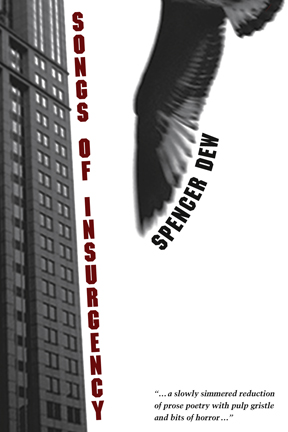
Songs of Insurgency (Vagabond Press, 2008)

TNBT: What else about your book might pique the reader’s interest?

Spencer: In Boulder I knew a woman who collected used tampons from public toilets for an art project she had in mind. It was slow going, as you might imagine, and not without its own set of risks. So she bought some pigs’ blood, to make her own used tampons, in mass. She tried to microwave it. That is where I learned about what happens when you microwave blood, which figures in the book.

Maybe that will only pique the interest of a certain sort of reader? The history of Ohio is important, and things like paper place-mats, all-night diners, youth in ill-considered and ill-aimed rebellion, kindness to animals, true love. Like I said: there’s Kenneth Patchen all over the place.

Blog Hop: Here’s who Spencer Dew tags and why:

I know Jill Summers from Chicago, where she is a pillar of the performance scene with stories at once hilarious and heart wrenching. She made a puppet show about Dracula before that movie came out, and it was at the Chicago Cultural Center, which is profoundly badass. Her work has been featured on National Public Radio and tons of other places (Monkeybicycle, Make Magazine, Annalemma, etc.). Her website is http://dottysummers.com/

I have never met Kristina Marie Darling, but the three books of hers I’ve read have been astounding. She has an approach to literature which, as I imagine it, has been equally informed by close attention to visual art (the assemblages of Joseph Cornell, for instance) and to that stuff that gets lumped as “theory” (by which here I mean a spread that runs from the private letters of Sigmund Freud to the musings of Maurice Blanchot). Darling constructs meticulous texts from varied sources, with entrancing results. Her website is http://kristinamariedarling.com/

These two are writers I’d recommend to anyone, and urge everyone to follow.

*****

Thanks to Spencer Dew for participating in The Next Big Thing Blog Hop, a franchise someone who isn't me invented and started spreading around the literary blogosphere many months ago.

Stay tuned for Eric Nelson's Next Big Thing answers later today and Jill Summers' next week. And I hope that Ocean Capewell will be blogging her answers on her blog sometime this week.

Monday, November 29, 2010

Small Press Holiday Recommendations: Day 20


I’m really surprised that only one person on my seasonal blog has recommended INFERNO: A POET’S NOVEL by Eileen Myles (OR Books), because it’s definitely been the most talked about and enthusiastically recommended book among my Facebook friends and acquaintances. Many of these recommendations have just been in the form of: Buy it. NOW. Others have been a bit longer winded, like, “Buy this book for every female artist you know.” Still others have paraphrased ideas from the book in their status line, like “Eileen Myles writes that she knew she was probably a lesbian, but wanted to become a poet first.” I really liked a concept that one writer paraphrased: “Eileen Myles’ Inferno reminds us that for a scene to be COOL, there must be mixing of the classes. There's a cash transaction to support the artists, but the artists come with gifts, fresh from the struggle to live.” (Since Myles often writes about her working class background but most artists I know do everything they can to wish away their dayjobs, I remembered this in my mind as “Artists need to learn how to earn a living, because part of their job is to depict the struggle to live.”)

One of my newest Facebook pals talked to Eileen Myles about writing and publishing the book, here: BombBlog podcast—Eileen Myles and Jackie Wang.

INFERNO is available mainly from the publisher, OR Books, or from select independent bookstores. I just bought my copy from my favorite New York bookstore and am anticipating its arrival on my doorstep. I can't wait.