Today I'm posting the first in a
series of interviews with small press writers and reviewers about the
art of book reviewing, and the
state of book reviews. In the process of getting reviews for my own books and for books I published by other writers, I've been paying closer attention than ever to reviews. I have noticed a wide range of quality: There is quite a wide variety of writings that call themselves reviews in this new media world. But the word "quality" doesn't even get at the variety I'm talking about--that sounds like I like one person's writing better than another's. But there is the quality of the writing, the quality of the critical thought, the quality of the reviewer's idea of what a book review should be, and more. Has new media itself degraded (or evolved) the idea of a book review? To some writers, the blog format seems like a good excuse to write a casual review that may be even less thoughtful than a blurb. To other writers, a Goodreads account is a fine platform to write intelligent responses to steady reading. And there are plenty of writers, young and old, who are writing well-considered book reviews and getting paid much less than they were a decade ago, or not getting paid at all.

Today I'm interviewing
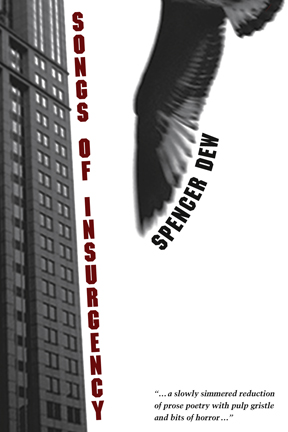
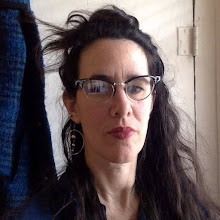
Spencer Dew, who writes fiction short and long, teaches Religious Studies, and is the author of a critical study of Kathy Acker. Spencer is a staff reviewer at the online litmag
decomP magazinE and a regular reviewer at the long-running small press review,
Rain Taxi Review of Books. You can find his reviews at those respective sites, and his writings and interviews here:
http://www.spencerdew.com/
Karen: Paul Theroux has said (in an introduction to his book, Sunrise with Seamonsters) that
writing book reviews is a "much greater necessity for a writer
than teaching how to write at a university, or leading seminars on literary
culture." What do you think?
Spencer: What a strange quote! Collecting marbles is
a greater necessity for a writer than hoarding scraps of yarn, but,
of course, neither of those things is actually
necessary.
Now, since “writing book reviews” requires reading,
and, ideally, requires critical reading, reading that attempts to analyze
the technique employed, to figure out the mechanics of how the text
works, how it was put together, and since it’s an act not just of
engagement or experience or feeling but also concerted second-order
stuff, contemplation and then the articulation of the results of that
contemplation, “writing book reviews” is one practice that hones
skills necessary for a writer, to be sure. But that doesn’t
mean a writer needs to write book reviews, per se.
Karen: What do you believe a book review should DO? What's its job? Is it
an opinion piece, an educated bit of contextualizing, an encounter between
one peculiar reader and one particular book, or is the reviewer supposed
to take the book on its own terms—after determining and naming those
terms? Is it the book's job to reach the reviewer or is it the reviewer's
job to find the pulse of the book?
Spencer: I think the job of the review—and the reviewer—depends
on the publication, but I can give you a handful of examples from my
work for
Rain Taxi.
When I reviewed Julia Scheeres’s book on Jonestown,
A Thousand Lives, I located this book within the scholarly and popular literature on Jonestown,
showed what was new and effective in this treatment, and debunked some
of her inflated claims about being, as her subtitle unsubtly and incorrectly
states, the “untold story.” I assumed that readers of my review
might have heard of this book and had certainly heard of Jonestown but
probably hadn’t read anything on it before; I wanted to give some
sense of what was out there and how this book stacked up against those
other sources (including Stanley Nelson’s 2007 documentary for PBS, a source which casts a heavy shadow on Scheeres’s work). If you’re going to read more than one book on Jonestown, Scheeres provides something useful; but if you’re only
going to read one book on the topic, this isn’t the one you should
read. That is an informed opinion, drawing on the fact that I
routinely teach about and teach books and articles on Peoples Temple
and Jonestown, as well as the fact that I spend a great deal of time
critically evaluating books.

When, to offer another valence, I wrote my review
essays of the collected work of Michael Muhammad Knight for the comic
book series
Hellblazer, I began with
the strong desire to draw attention to these pieces and, in my reviews,
to analyze them in new ways. I offered an overview of Knight’s
oeuvre, some thoughts on why he is an important voice in the contemporary
scene, and advances a criticism of misogynistic tendencies and the tricky
way he presents such tendencies in his works. On
Hellblazer I argued for
a central tension throughout the series between oppressive forms of
authority and the temporary liberations provided by friendship.
Parliament versus the pub, or something like that—but, again, what
I was doing was saying, look, these are neat books, rewarding in many
ways, and one thing that’s going on here, that is important and fascinating,
is this. That is also a function of the review, a task of the
reviewer.
Writing on Jarett Kobek’s novella
Atta, a book about the
9/11 hijacker and including scenes describing the hijacking, I tried,
foremost, to show what and how Kobek was doing what he was doing and
raise a series of questions about both underlying claims about a certain
mode of Islamic education—recitation and memorization, with its solid
Quranic roots, which is played up here as central to Atta’s fanatical
mindset—and about why an artist might engage in such an exercise of
entering into the mind of a historical figure like this. I hope
I provide, in the end, some tools for wrestling with a book that, I
believe, was designed to be wrestled with.
One final example: the linked stories in
Maleficium, by Martine
Desjardins, were seductively creepy, and reading them—-with, sure,
the knowledge that I was going to write a review of the book—-I got
lost in the decadence, the texture. My review was largely an appreciation
of what I took to be the most compelling qualities of the storyline
and the prose, with ample samples of the latter for the reader to experience
as a kind of preview.
This is by no means an exhaustive typology of how
book reviews function, but these examples do address your question.
Karen: There's all these levels of reviews out there. It's no longer just
the New York Times Book Review, literary journals, and your hometown newspaper.
Now it's also blog reviews, online litmag reviews, Amazon and Goodreads
reviews, and all the places that Amazon and Goodreads reviews "show
up," too—like Worldcat or Google searches. Likewise, one reviewer
might cross-post their reviews in several spots online—LibraryThing,
Goodreads, Amazon, etc. In your view, what has this expansion done for
the standards of book reviews? Do you think that today's online readers
are simply "savvy enough" to process the different expectations
of different venues? Or do you see more poorly-written, poorly-thought-out
reviews being generated overall?
Spencer: There is a real distinction between thoughtful criticism
and the simple “reviewing” that occurs when someone gives stars
or thumbs or offers a few words in praise of a recent Panini on Yelp.
Putting thumbs and stars on things can be very useful in some situations—I
don’t want to go to a bad dentist, for instance, and I like living
in a world where feedback can be provided on such services—but this
isn’t the same as the work of a critic, which needs to be broadly
informed and involve serious engagement and consideration. My
experience with Amazon reviews has not found them useful; my experience
with Goodreads, which is quite slight, has mainly been to offer me a
list of books that folks I know have or want to read, which is like
walking into someone’s house and looking at their bookshelves, which
is nice. There are some great bloggers and great online literary
magazines.
This might be a tangent, but a few days ago I was
meeting with a friend who brought up the fact that a major independent
bookstore here in Chicago has been fighting bankruptcy for years and
only continues to exist due to some rather miraculous subsidies.
My first impulse was to say, well, it would be a shame if that store
closed, but when I really thought about it, what I value about the existence
of that store is that I can walk in and see some well curated tables
offering me a sampling of new books I wouldn’t otherwise know about.
I don’t buy books there, because books are very expensive. I
read almost entirely via the great public library system of the city
of Chicago, when I’m in Chicago, and via Interlibrary Loan when I
am elsewhere. So—without delving more into this issue of bookstores
and their functions, one you have written on with eloquence elsewhere—I
think that lists of books, with or without stars, on Goodreads or Amazon
or blogs or lit magazines can be profoundly useful for precisely this
sense of discovery. But what the bookstore has is one guy who,
like an editor of a literary review, carefully curates what motley assortment
of books will be on display, vetting them, vouching for them.
His is a kind of discernment that can be, as you say in your next question,
“trusted.” And that is a valuable thing.
Karen: What do you read a book review to find out? Where do you like to
read book reviews? Do you trust certain journals or certain reviewers?
Do readers of book reviews think in terms of "trust"?
Spencer: I read
Rain Taxi every quarter
in print and follow all of their on-line updates, I read the
New York Times book review section every week, I read most of the stuff that the
New York Review of Books posts on-line, and I follow links from
Arts and Letters Daily
to assorted reviews. I at least flip through and read around in
the reviews in the
Journal of the American Academy
of Religion (because I’m a religion professor), and I visit
sites like
Spiked Review of Books,
and
The Guardian’s book
section every few months. When I’m at a good bookstore and feeling
flush I’ll buy a
Bookforum and
London Review of Books.
As for “trust,” I trust the editorial staff
of these places to attempt to pair talented reviewers with interesting,
worthwhile books. One of the reasons I started writing for
Rain Taxi is that I read
Rain Taxi and knew lots
folks (first out in Boulder, the Naropa crowd, etc.; then in Chicago)
who read
Rain Taxi and respected
what it was doing in terms of covering small presses, poetry, stuff
you most folks wouldn’t otherwise know about. So I read
Rain Taxi to get a sense
for new books out there in the world; I probably put in an Interlibrary
Loan request for four books out of every issue, on average.
Karen: Do you think all books assigned should be reviewed, or can you imagine
a situation where a reviewer just doesn't have an interesting enough
engagement with the book to produce a worthwhile review essay?
Or is there, in fact, a science to reviewing which can produce (with
some consistency) a thoughtful essay?
Spencer: One can produce a “thoughtful essay” on even
a rancid piece of writing, but the question would be
why. If a non-fiction
book makes an argument that needs to be debunked, say, or a book of
poems expresses a fascist sensibility that needs to be challenged—those
are solid reasons for a necessary and useful review of a “bad” book.
There’s another situation that is a more common
occurrence for me: with
decomP, I try to review
as many of the books that come in as possible, as a kind of service.
I feel a responsibility to seriously engage with these works, a responsibility
to the authors. So, for instance, I reviewed a few years back
a book that was really quite awful—just bad writing, sloppy, boring,
self-important, etc. But I wrote a lengthy essay on it, and I
gave lengthy quotes from it. I wanted anyone reading the review
to see that I was giving the book a fair shake, letting the book speak
for itself, but I also wanted the author to know that I had not tossed
out the book halfway through but mucked through it and given it a compassionate
and critical reading, flagging what I took to be serious problems in
a way that would be practically useful for the author. Here I’m
afraid I sound like a teacher, which is also what I am: you don’t
just stamp a paper with a D, you have a responsibility to clearly explain
why the paper earned that grade and how it could be improved, etc.,
etc. For a publication like
decomP, which is rooted,
as I understand it, in a notion of literary community, the function
of book reviews must also reflect that ideal—and there is, then, a
pedagogical function; the book review isn’t just a blurb about a book
worth reading, it also is a chance to talk about what makes good writing
and about how writing works.
 Karen: This particular blog (Karen the Small Press Librarian) has a
policy of running largely positive reviews, because I don't think that
small- and micro-press books should be buried before they have a chance
to live. Not that I ask anyone to lie about their true feelings for
a book, but I have declined to run some negative reviews. Thanks for telling
us a bit about the delicate art of writing critical reviews of little-known
authors.
Spencer:
Karen: This particular blog (Karen the Small Press Librarian) has a
policy of running largely positive reviews, because I don't think that
small- and micro-press books should be buried before they have a chance
to live. Not that I ask anyone to lie about their true feelings for
a book, but I have declined to run some negative reviews. Thanks for telling
us a bit about the delicate art of writing critical reviews of little-known
authors.
Spencer: Thanks so much for including me in this discussion, and thanks, even
more, for your support of and investment in, via things like this excellent
blog, the ideal of artistic community.
*****
I want to thank
Atticus Books for their discussion series,
Six Degrees Left, which was an inspiration for this forthcoming series of interviews. While Atticus publishes the interviews in panel discussion style, I enjoy their intelligent questions and relevant topics.
I'd also like to thank writer
Tim Hall for pointing out that "More people are indeed reading more these days; but what they're actually reading is online product reviews." Thus, the Amazon book review may not be so easily dismissed.