Showing posts with label Chicago. Show all posts

Wednesday, January 9, 2013

The Next Big Thing Blog Hop: Spencer Dew


Spencer Dew at his desk

The Next Big Thing is a weekly blog hop with a standard set of questions for writers to answer about their forthcoming book projects. Last week I answered questions about my bookstore memoir, and as it turned out, two out of the three writers I tagged don't have their own blogs, so I'll be blogging their answers here today. This installment features novelist Spencer Dew. I had the pleasure of reading an advanced copy of Spencer's novel and I can't wait for it to come out in March on Ampersand Books: it's smart and hilarious and has its finger on the pulse of something very American. I'll let him tell you more:

*****

The Next Big Thing: What is the working title of your book?

Spencer Dew: Here is How it Happens. It is a novel about Northern Ohio in the 1990s, about a specific place and a specific time, plus those ways that place and time get turned to something in our memories—nostalgia, for instance, or the expectation of hindsight in the moment, if that makes sense. It’s a story about kids at a college in a small town, and they try to overthink things, strain to paste pretty words on their situations.

TNBT: Where did the idea come from for your book?

Spencer: The original idea came when I was in college myself. I wrote what I thought was a short story the second semester of my senior year, and before I dropped out of an MFA program I was told it wasn’t a short story but the start of a novel, so I wrote a novel, and then I rewrote it, a few dozen times.

TNBT: What genre does your book fall under?

Spencer: It is a novel. I don’t know all the marketing categories, but I guess it gets shelved in either “fiction” or “literature” or maybe “indie/small press,” unless you shelve it in a store or library in Northern Ohio, in which case maybe you’d call it “local,” though it wasn’t written in Ohio and I haven’t lived there since college.

TNBT: Which actors would you choose to play your characters in a movie rendition? 

Rick Gonzalez should be Eddie Yoder. That one’s for sure.

TNBT: What is the one sentence synopsis of your book?

Spencer: Courtney and Martin have practiced their cynical in-jokes and nonchalant pose, but beneath this façade of self-satisfying ennui, these kids are staring down their futures and facing the traumas of their pasts.

That one sentence sounds a bit serious, however. The kids are serious, or semi-serious, or their situations—those traumas of their past, as well as their dead-end but still-living relationships—are serious, a serious problem, but the novel itself is comic. I wrote it and all, but it cracks me up. Reading the galleys I laughed out loud. That, to me, was also the mark that the manuscript could finally be called “done,” that it could consistently make me laugh and keep reading.

TNBT: How long did it take for you to write the first draft of your manuscript?

Spencer: I wrote the first draft as a student at the Jack Kerouac School of Disembodied Poetics. It took me a couple of months. It was, shall we say, rough.

TNBT: What other books would you compare this story to within your genre?

Shiela Heti’s How Should a Person Be? Kenneth Patchen’s The Journal of Albion Moonlight. I guess it depends on the point of the comparison, but I’d be curious what people make of either of those. Patchen is a presence throughout, as a product of Niles, Ohio. The kids are always quoting Patchen.
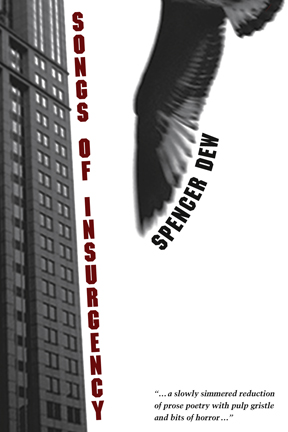
Songs of Insurgency (Vagabond Press, 2008)

TNBT: What else about your book might pique the reader’s interest?

Spencer: In Boulder I knew a woman who collected used tampons from public toilets for an art project she had in mind. It was slow going, as you might imagine, and not without its own set of risks. So she bought some pigs’ blood, to make her own used tampons, in mass. She tried to microwave it. That is where I learned about what happens when you microwave blood, which figures in the book.

Maybe that will only pique the interest of a certain sort of reader? The history of Ohio is important, and things like paper place-mats, all-night diners, youth in ill-considered and ill-aimed rebellion, kindness to animals, true love. Like I said: there’s Kenneth Patchen all over the place.

Blog Hop: Here’s who Spencer Dew tags and why:

I know Jill Summers from Chicago, where she is a pillar of the performance scene with stories at once hilarious and heart wrenching. She made a puppet show about Dracula before that movie came out, and it was at the Chicago Cultural Center, which is profoundly badass. Her work has been featured on National Public Radio and tons of other places (Monkeybicycle, Make Magazine, Annalemma, etc.). Her website is http://dottysummers.com/

I have never met Kristina Marie Darling, but the three books of hers I’ve read have been astounding. She has an approach to literature which, as I imagine it, has been equally informed by close attention to visual art (the assemblages of Joseph Cornell, for instance) and to that stuff that gets lumped as “theory” (by which here I mean a spread that runs from the private letters of Sigmund Freud to the musings of Maurice Blanchot). Darling constructs meticulous texts from varied sources, with entrancing results. Her website is http://kristinamariedarling.com/

These two are writers I’d recommend to anyone, and urge everyone to follow.

*****

Thanks to Spencer Dew for participating in The Next Big Thing Blog Hop, a franchise someone who isn't me invented and started spreading around the literary blogosphere many months ago.

Stay tuned for Eric Nelson's Next Big Thing answers later today and Jill Summers' next week. And I hope that Ocean Capewell will be blogging her answers on her blog sometime this week.

Thursday, September 22, 2011

Guest Review: LIFE AFTER SLEEP Reviewed by Joel Thomas


Mark R. Brand. Life After Sleep. Chicago: CCLaP Publishing, 2011. Fiction (novella). Available as an e-book or in handbound edition. http://www.cclapcenter.com/lifeaftersleep/

Mark R. Brand’s sci-fi novella centers around the premise that through the wonders of science, humans can get by on significantly less sleep. A device referred to as a “Bed” allows for full rest in only two hours. Will we use the extra hours in our day for education, cultural enrichment, and making the world a better place? Will we finally get around to donating blood and going to the gym regularly? Or will we simply possess a few more hours each night to help us keep up with our favorite reality shows? Surely we can find more “Real Housewives” adventures to follow, and their own reduced need for sleep will provide even more snippy banter and social catastrophes.

Fortunately, Brand takes readers down a more interesting road. His own background in science and medicine informs the novella throughout, allowing him to provide detailed exposition and explanations of the technology itself and its effects on each protagonist. As we all know, the literary world of tomorrow’s technology often turns out to be a curse more than a blessing, and this novel displays the personal dystopia that is Life After Sleep. Capitalism always wins, of course, and readers soon learn that corporations expect humans to work many more hours, often for less pay. The most glaring example: a war veteran with PTSD working an inhumane number of hours at a futuristic version of Walmart. His Sleep (Brand refers to the shortened version of sleep with a capital letter: “Sleep”) struggles prove nearly devastating, as do the hallucinations of a rest-deprived surgeon who blacks out during operations.

Even with an overarching social theme, the narrative stays focused on individual lives rather than sweeping political statements. This move keeps the novella lean and intimate. Readers meet characters who stay vulnerable and believable, beset by problems and conflict but never forced into saving the world. One major narrative branch, for example, portrays the difficulties of a couple trying to adapt back to more traditional sleep patterns after having a baby. As it turns out, Beds aren’t safe to operate near infants. The young father/husband works too many hours without the benefits of a Bed and its technology-enhanced Sleep, and the young parents both struggle to adapt to their physical needs for rest. In another vein, a successful band promoter pushes the legal and physical limits of Sleep while dabbling in other intriguing technologies (which this reviewer will leave unspoiled so the reader can take pleasure in discovery). Her own desperate lifestyle brings a hedonism and danger-driven appeal to the book.

With Life After Sleep, Brand doesn’t push extremes, keeping a sense of relative believability. Some readers may prefer fantasies so unbelievable that the enjoyment comes from reveling in the seemingly impossible, but this novella’s appeal comes in its chilling likelihood.

Recommended for collections of contemporary fiction, science fiction, medical fiction, and Chicago authors.

Available from the Chicago Center for Literature and Photography, or from Amazon.

Reviewed by Joel Thomas
Midwestern adjunct writing instructor
http://thecasserolex.wordpress.com/

Thursday, August 4, 2011

August 10th Book Party: Chicago Center for Literature and Photography Celebrates Four Years


Jason Pettus is a writer, photographer, and founder of the Chicago Center for Literature and Photography. CCLaP has been an unique kind of cyber-center for the small press since 2007, offering a number of amenities to the literary community of Chicago and beyond. CCLaP is a publisher of e-books by emerging authors; a blogger of book reviews, movie reviews, and essays; a creator of podcasts with authors a few times each month; and a host of Chicago reading events. They have published four e-books thus far: Life After Sleep by Mark Brand, Salt Creek Anthology by Jason Fisk, 99 Problems by Ben Tanzer, and Too Young to Fall Asleep by Sally Weigel. In honor of the upcoming fourth anniversary book party (August 10th at Chicago's Beauty Bar), the books are now available as hand-bound editions as well, something Jason calls "Hypermodern Editions."

As the Center's anniversary approached, Jason answered some questions for me on building a readership, the state of the book review, and the Chicago lit scene.

What led you to start CCLaP?

I was a working author myself for about ten years in Chicago, then back in Missouri was a working photographer for around five years previous to that; and coming from the punk/zine community of the 1980s when I was a teen, I've been doing fun little DIY creative projects for a long before either of those. So when I first entered middle age in the mid-2000s, and started becoming more and more dissatisfied with trying to continue pursuing a career as a creative writer, something like CCLaP was just naturally one of the first things that popped into my mind as something to do next with my life. Although truthfully, I came very close to opening an internet startup company instead (that's what a lot of my day jobs in Chicago have involved), in which case CCLaP wouldn't actually exist right now.

How has the reception been for the e-books you’ve published so far? I’m not trying to single out your authors, but more to ask how you reached out and found an audience, and what you learned about how to find your readers in between Book #1 and Book #4.

When I talk to my friends who run more traditional basement presses about this subject, it looks pretty certain that in general terms, CCLaP is generating the same amount of paying customers from the ebooks as they are from their paper books, which as most people know is nothing to sneeze at but no great shakes either. The nice thing, though, is that since the ebooks are released under a "pay what you want" scheme, it means that our paying customers only make up around 25 percent of the book's total readership; and so if you're talking just about how many eyeballs the center's books are getting in front of, you can think of it in general terms of about three to four times the amount of a typical basement press. The biggest lesson I've learned so far about gathering an audience is that this stuff really does fall along traditional age lines to a great extent; so that is, whenever I publish a middle-aged author with a middle-aged audience, downloads of the electronic version are always smaller than a title by a twentysomething with a college-aged audience, even when that book will often generate the same amount of press and interest away from the internet. The adoption of ebooks is truly a generational issue, I'm slowly learning.

What do you look for in a writer you’re deciding to publish?

Oh, it's a whole complicated host of factors, actually. Obviously the first and main issue is simply the quality of the actual manuscript; but then whether or not they're in Chicago comes into play as well, since that's so much more a convenient option for things like getting them to sign books, etc. And since part of CCLaP's mission as a more general overall arts organization is to help nurture artists over the course of their careers, part of what I look at when examining submissions is where that author is in their career, and how much a CCLaP book would be able to help with the long-term picture; so if someone like Ben Tanzer comes to me, for example, who now has a number of successful commercial novels under his belt, but is sitting on something more experimental or personal that will make his audience think of him in a new way if someone were to publish it, that counts for extra in my mind when making decisions about what to put out.

I think it’s great that you’re making handmade books out of CCLaP e-book releases. Will you continue to do this, or do you think it’s more of a special event for the 4-year anniversary?

The paper versions of CCLaP's books have actually always been a part of the plan, since starting up the publishing program in 2008; it's just that it's only now that I've actually been able to afford it. In general I'm trying to take my cues off how many musicians now do things, which is to entirely skip the middle step of distribution altogether; so in my case, the plan has always been to release an electronic version that people can download for free if they want, and a handmade, hardback paper version that costs a little more than a paper version normally would, and that can be directly purchased at the website much like how an Etsy store works, and then just skip the trade paperback version and the bookstores and Amazon and the traditional distributors altogether. It's my opinion that this is where most small presses are bleeding the most money these days, so my hope is to keep costs under control by simply eliminating this option entirely.

I’m so glad you’re running frequent book reviews on your blog. In a time when newspapers are downsizing their book review sections and laying off reviewers, can you speak to the importance of book reviews in our culture?

Well, I'm just amazed that more people don't do the same thing! I think that blogs got saddled at the beginning of their existence with this bad reputation, as if they were some form of literary genre unto themselves and with their own artistic pluses and minuses; but really, a blog is actually just more a type of technology, a specific kind of medium for delivering whatever you want, good or bad, just like it would be ridiculous to say that a piece of content is somehow artistically better when read on a piece of ivory-colored paper versus cream-colored paper. In this sense, then, a blog is nothing more than a giant unending sheet of paper that's given to you completely for free, and so makes it the best medium in human history for long-form, thoughtful essays. I think once we get to the next generation of online users, the ones who don't automatically equate blogs with unthinking idiocy, we're going to see a flowering again of long-form critical thought that could scarcely be imagined by previous generations.

Do book reviews become even more important in a moment of so many publishers, underground publishers, self-publishers, and varied formats? Do book reviewers help hold The Book together as hyperlinks and e-readers try to morph it?

That's a good question, and I confess one I've never really contemplated before. Certainly you paint a vivid mental picture of "artistic thought" being some kind of runny goo, and that different conventions like "novels" and "feature films" are differently shaped boxes that we put around this goo to try to contain and shape it, so that we can then put two of them side-by-side and compare them. Does our society need this in order to even understand the arts, and for it to be of any practical help in our day-to-day lives? And is it important for critics to continue holding up the "novel-shaped" box, when things like narrative videogames and hyperlinked stories create little holes in the corners for that goo to ooze out? I think those are more philosophical questions than practical ones, and probably better debated at dinner parties after a few drinks than a declarative answer given here.

If the big newspapers were considered reliable sources who often had the last or loudest word on book reviews, what should a reader look for in seeking trustworthy reviews in the blogosphere? Is the dismantling of the newspaper reviews a good thing or a bad thing for the small press?

Deciding which critics to trust has always boiled down to some simple criteria in my opinion, and I'm always surprised that so many people have a hard time with this, which is merely trust plus time. Too many people, I think, have this attitude towards critical thought that's similar to God speaking to His minions, that it's this booming random opinion coming in out of nowhere that we should blindly trust merely because someone in a position of authority is telling us to; but finding a good critic is actually much more similar to paying attention to the opinions to a good friend, in that the entire reason we even trust what they're saying is because they've proven over and over again that they CAN be trusted, precisely because they have very similar opinions to our own. That's always the best way to get good recommendations, I've found, is simply to find people whose tastes closely match your own, then pay attention anytime they rave about something you've never heard about, or argue for a project that you may have not cared for at first.

I think a big part of the problem occurred during the big Hollywood boom of the 1980s, when newspapers suddenly found themselves with an opportunity to sell many more pages of movie ads if they simply had an excuse to actually print those pages; that forced every newspaper in the country to hire their own staff of reviewers, who were basically no more than an excuse to even have a pullout movie section every Friday and sell a thousand percent more ads than they were before. That's when you really saw the first big proliferation of this "From God's Mouth" attitude about criticism, where critics became an endless series of faceless anonymous shills, and the only reason you would put stock in any of their opinions is because this big expensive newspaper was telling you to; and then when this became a successful paradigm, it of course bled over into things like book reviews as well. So in that sense, the dismantling of the newspaper review system is the best thing that could've happened to both readers and small presses; because what's rising in its wake is both the much more reliable crowd-sourcing process at places like Amazon (which, let's face it, is a HIGHLY trustworthy way of learning simply about any particular book's general strengths and weaknesses), combined with long-form critics like myself who take our cues off the old masters like Pauline Kael, who people trust in the same way they trust their friends, and who can recommend unknown things in a way that Amazon crowd-sourcing never could, no matter how sophisticated their algorithms get.

What have you learned about small press publishing since setting up shop in 2007?

Oh, dear, we could be here all day if I started to answer this, so perhaps I'll just skip this question altogether. The short answer is that I've learned hundreds of things, and that the very best advice I can give a person who's interested in the subject is to simply go out and start a small press themselves, to learn all the hard lessons they never will simply by reading about other people's experiences.

Chicago has a thriving small press scene: From afar, I know about Quimby’s, the Orange Alert Reading Series, the Chicago Underground Library, Another Chicago Magazine, the Chicago Zine Fest, the “Quickies” Reading Series, MAKE, Featherproof Books. Have you paired up with any of these folks in your events or in other ways?

I have yet to formally partner with any of these groups, but you could absolutely say that an informal network of support exists here in Chicago within this community: we all tend to go to each other's events, buy each other's books, provide publicity for each other's big things, recommend artists to each other, send submitting authors each other's ways, etc. In fact, back when I quit writing myself in 2004 and was first coming up with the idea for CCLaP, this is one of the main reasons I decided to follow through with the particular plan I did, was knowing what a strong and longstanding literary community there actually is here in Chicago, which now that I've traveled a bit I can confidently state as one of the largest and most tight-knit ones in the world.

What’s on the horizon for CCLaP?

Well, more books for a start -- another three before this year is through, then another five in 2012. And more live events, more podcast episodes, and the same 150 book reviews at the blog next year as I publish every year. Plus it's looking likely that we'll finally be offering our first classes and workshops next year as well; because I have to say, the requests never stop coming in from people wanting to learn how to make the kind of handmade books I do for CCLaP, so I'm thinking strongly of just charging a fee and teaching the people who really do want to sit down and learn. Then of course the center has a long-term vision as well, for those who don't know; everything being done right now, for example, is in service of hopefully one day finally opening a permanent physical space somewhere here in the city, at which point CCLaP will morph more into the traditional community center that I've always envisioned it as.

*****

Find the Chicago Center for Literature and Photography online here.