Monday, September 16, 2013

Writer on Writer: Part Two, Alex Kudera Interviews Dave Newman

Following up on last week's Writer on Writer interview, this week Alex Kudera interviews Dave Newman. Alex is author of Fight for Your Long Day (Atticus Books, 2010) and Dave wrote Raymond Carver Will Not Raise Our Children (Writers Tribe Books, 2012). Each novel looks at the struggle of one writer trying to pay the bills by adjunct teaching. At my request, Alex and Dave read each other's books and came up with their own questions.

*****

Alex Kudera: Winning an award named after Andre Dubus is an amazing accomplishment. Are you a Dubus fan? I like almost all of his novellas, the story "Townies," and many more. Do you have any favorites among his writings?

Dave Newman: I love Andre Dubus. I’m a huge believer in the American small press, and I read all his books on Goodine, which was one of my favorite presses at the time. Dubus was one of the first writers I fell in love with, and his stories and novellas meant so much to me when I first started reading. I’m glad he’s so revered now, but I wish he would have had more success when he was alive. Both the movies based on his work, which I’m sure steered readers back to his books, came out after he died. My favorite Dubus’ books are actually his essay collections. Some of the best writing about being a writer—and the morals of being a writer—are in those collections. I love that he was committed to writing as a spiritual pursuit. I love that he was honest about writing and money and how those two mix. He knew that the important thing was to write the best book you could write and to have the book reach the world. It’s obvious that he cared deeply about his characters, and from things his son and last wife have said, it’s obvious that his love of writing sometimes distracted him from his familial obligations. I love his wife’s letter to Poets and Writers, where she says, basically, “Quit fucking saying I took Andre’s kids away from him.” I thought that was badass of her.

Alex: I also recently read his son's memoir Townies, and it was illuminating to get that side of Dubus as father. I didn't love the memoir in every way, but one tidbit I loved is how he tells his son it's okay to write about his parents, that he should do it if he is compelled to. To me, that's refreshing and quite writerly. From what I've read of your novel, it seems like you are very much in favor of this sort of honesty. Is that possibly the main trait we look for in writing?

Dave: I have Townies but haven’t read it yet. As I said above, Andre the Dad seemed like a difficult person but he was conscious of that, so it makes sense that he would encourage his son to pursue honesty in his own writing. I think honesty is the main trait we look for in writing, and I think that’s why we sometimes forgive writers who have stylistic lapses. I want to puke on the sentence people who feel like lines can be separated from characters and narrative. That’s a fashion show. It’s literature as pornography. It always pisses me off when people include Ray Carver and Barry Hannah in that discussion. Both Hannah and Carver wanted to tell stories, and they did so in a language that served their narratives. Carver wrote great poems and stories after he broke from his editor, Gordon Lish, who is a sentence asshole. When Hannah went too far with language, when he failed in storytelling, and when he was criticized for it, he admitted to fucking up and losing control with language. He wasn’t proud of it. He didn’t want to be someone who was known for writing sentences. He wanted to tell the truth about the world. So yeah, me too.

Alex: I am aware of the writer as bad father, and there are too many great writers to name in this regard, literary superstars with multiple wives and children, guys who walked off the job early and often. I see your awareness of this in your novel, and it sounds like you very much are intent on staying in one marriage, of making your family life a success. Is this something you were thinking about from a young age, or something you became more aware of once you became a husband or father?

Dave: I didn’t ever plan on marrying. I figured it was an either/or situation. You either wrote, which required hours of reading and writing, or you got married, which required hours of marriage stuff, whatever that was. Then I found myself in Vegas, getting married to a woman I barely knew, and I was unbelievably happy about it. My wife is awesome, and she’s a great writer, and we support each others’ writing in every way possible. It really speeds up the process to know you have someone in the other room who wants to read your writing, not is willing to, but wants to. We both have three published books now. We had a combined total of zero books before we were married. I think a lot of people perpetuate the myth that you have to be a shitty person to be a writer, or that you have to be a terrible spouse to be a writer, but as I got older I started to realize some of those myths were coming from shitty people who were also shitty spouses. My wife and I both want to be successful parents, more so than successful writers, but we’re both conscious that writing makes us better and happier people, which makes us better parents, so we strive for that balance. There’s a lot to give up, some hard and some not, if you want to be a parent / writer / decent person. Don’t watch junk TV. Don’t see terrible movies for the distraction. Don’t hang out with your neighbors just to be a good neighbor. Don’t hang out with anyone you don’t want to hang out with, unless it impacts your kids by not hanging out. Vacation exclusively for your children. Eat cheap. Go to elementary school open houses, smile a lot, and get the fuck out as fast as possible. I never go and see the same writer read from the same book twice. I never flew to New York to read to four people in a bar just to say I was on a book tour and read in New York. I try to be productive when I’m not being productive. When I drink beer, I will often spend the first hour cleaning the house with loud music playing, so I’m not just drinking but cleaning and catching up on tunes. Only watch sports you love. I only watch the Steelers now, and I usually fold clothes while the game is on. If my kids want to hang out, we hang out. If my kids want me to play with them and their friends, I politely decline. They can amuse themselves. I make time for my wife to write because she gets more easily swallowed into the world than I do. When I need to write, she puts the bubble around me and keeps the world away. I still do shitty things all the time, but they’re usually on accident, and I try to learn from my shittiness. One of my goals is to be less shitty, to help more people. That’s how I want to be in the world as a parent and husband and writer, all at once.

[The interview continues]

Sunday, September 8, 2013

Writer on Writer: Dave Newman Interviews Alex Kudera

Several months ago, I asked small press authors Alex Kudera and Dave Newman if they would be willing to read each other's latest novels and interview each other about them. Each novel features a protagonist struggling to make ends meet (and keep a writing life) while working as an adjunct professor: Newman's novel, Raymond Carver Will Not Raise Our Children (Writers Tribe Books, 2012) follows instructor Dan Charles, a family man with one published novel under his belt; Kudera's Fight For Your Long Day (Atticus Books, 2010) is narrated by the unpublished Cyrus Duffleman.

I'm posting the resulting interviews in two parts. Stay tuned for Part II: Alex's interview of Dave, which I hope to post later this week. Without further ado, Dave Newman interviews Alex Kudera about Fight For Your Long Day.

*****

Dave Newman: How scary was it writing a book about a frustrated adjunct instructor while working in the academy?

Alex Kudera: Writing it wasn’t scary at all. It was thrilling and cathartic for the first summer when a whole draft came out, and then there was a lot of painstaking work to improve it, and the fear of failure is always lurking in the background, yes, and then toward the end, there was doubt, but I didn’t have actual fear until I was waiting for the reporter at Inside Higher Ed to call. My first interview was by telephone, and I had no idea what he would ask or how I would respond. Despite my own ten years of adjunct teaching, I was ignorant of many different aspects of the national situation. Publishing the book has gotten me in touch with a full range of concerned academics, struggling adjuncts and tenured professors, and I’ve learned a lot about higher ed since the book came out.

It’s important to recognize that hundreds of thousands, maybe millions, of indebted students and low-wage adjuncts and contract workers, folks just like us, families with children, are scared. Their legitimate fears are about how to put food on the table, how to afford utility bills, gas, and rent. Maybe the new healthcare laws will help in one important area; I hope so. But overall, if you think about it, the capitalist system can reward hard work, but it can also reward connections, ass-kissing, and greed, and the work, whether hard or “crafty,” is typically legal, but with occasional outright malfeasance, and sometimes the laws themselves can even be bought and changed to favor the wealthy or connected, and many folks who gravitate toward the top in order to save their own fiscal asses seem barely sentient enough to recognize the extent of the problems, never mind care enough to do something substantial. You look out and see what goes on, and you wonder how they ever came up with the idea of actually referring to us collectively as “humanity”; that’s one of the all-time great sales pitches, I’d say.

So whether I write this book or another book or don’t write anything at all, I’m going to be scared sometimes—scared for my kid, scared for your kids, and scared for little ones throughout the country and around the world. But sometimes, we have to put aside our own fears to try to help others.

DN: Have there been any repercussions?

AK: I believe that there have been, and yet I’m uncertain I’d be able to prove it. Academia also offers a lot of opportunity for paranoia, both individual and collective, so it’s all hard to say. Overall, it seems some tenured professors have reacted quite favorably to Fight for Your Long Day (one assigns it to her graduate students in English education, and I know that at least two professors have assigned the novel; the other was for graduate students taking a course in ethics in higher education), and there are other academics, including adjuncts, who are somewhat uneasy with the novel, possibly its conflicted look at class and race, find it dull, or just aren’t able to read a book unless the main character is perfectly sympathetic in the most stereotypical ways. And, yes, I’m scared of “repercussions” too, and in academia, they are difficult to label as such because there so many factors that can be introduced as a reason why any hiring or other decision is made.

Dave: There are some big buzz phrases in the academy right now — community, literary citizenship, collegiality — but universities run on adjuncts and tuition doubles at twice the rate of inflation, and the machine keeps acting like a job is a gift. Can you talk about how (or if) the language of the academy — the Orwellian nature of it — fueled Fight for Your Long Day? Orwell would have loved your title, as I do.

Alex: Yeah, universities are full of “success centers” and slogans like “students first,” and we’ve come to call that all Orwellian and in some ways, it is. Did Orwell have much on nations jacking up the price of air and water? I suppose jacking up tuition every year and buying leather couches for top administration is not the same thing. In fact, I’ve never read 1984 although I’ve read Animal Farm and Down and Out in Paris and London and I enjoyed the latter very much. It’s a writer’s book, and I read when I was bussing my own dishes in Paris during a semester off from college.

On the other hand, sometimes it seems like things are changing for the better though. They’ve kicked the private lenders to the curb, and for government loans, there are forgiveness programs that aren’t publicized as well as they should be but base repayment on a graduate’s earnings and even forgive them outright if payments are made on time for 20 years (or even just 10 for careers that qualify as “public service”). It’s a strange game we’re in, and, frankly, where I am right now, the students seem to love the college experience and they seem barely cognizant of some of the ideas broached in my novel. That makes it seem all the more bizarre, and yet it’s pleasant here. The students seem happy.

True to my long-winded nature, for a long time, the working title was Arise Adjunct Duffleman, and Fight for Your Long Day. I didn’t snip off the front half until very late in the process. I think FFYLD was the title when I queried Atticus and a dozen others. That was a query several months after a failed round. In the Atticus round there was one other small press that seemed to be giving it serious consideration, and, well, as everyone knows, all you need is one “yes,” and that is usually all you get. I like a line from a Roberto Bolano story where he is describing Chilean exiles desperate for work in Europe, and he says the highest bidder was invariably the lowest one as well. It is tough out there.

[The interview continues:]

Wednesday, August 7, 2013

Must-Read Indie Publishing Interview: Rami Shamir


I’m thrilled that novelist and former Zuccotti Occupier Rami Shamir talks about what it means to be an independent author in this terrific interview at The Huffington Post. Self-publishing is not just about self-sufficiency: Shamir makes the distinction between the “self-publisher,” who in today’s digital/POD/Amazon/Kindle/Nook world is held hostage to corporations, and the independent author, who is someone seeking a literary community that can support our books outside of the corporate structure. What is an independent author but a writer, and what is a writer but someone whose voice is needed, now more than ever? "Now" is a time when corporations are pushing against humans baldly and with more impunity than we've seen in our lifetimes: pushing against human rights, against workers' rights, mowing down environmental safeties we'd like to take for granted. Gag orders, corporate buyouts and mergers of newspapers, and shrinking outlets for paid investigative journalism are all examples of the free market attack on free voices.We need writers who are free to speak.

Shamir challenges us as authors to boycott Amazon and Barnes & Noble—to pull our titles from those corporate predators. He considers independent bookstores to be “the new arsenals of American democracy,” fighting the good fight for the voices of authors and the visions of publishers they believe in, and the fight against Amazon’s ongoing late-stage-capitalist war on brick and mortars.

m. craig and Rami Shamir at Copacetic Comics, Pittsburgh (April 13, 2013)

I had the pleasure of meeting and hosting Rami Shamir and m.craig when they came through Pittsburgh on their Embracing the Accidental reading and distro tour in April 2013. Craig is the author of The Narrows and the founding editor at Papercut Press (Brooklyn). Together on tour, Shamir and Craig introduced their voices and their books to cities, booksellers, and writers across America, and established ties with 31 independent bookstores from coast to coast. They created a distro map of these stores for other independent authors to follow. Find it here:

View EMBRACING THE ACCIDENTAL: A Distro Map for Independently Published Authors in a larger map

Rami Shamir's interview also talks about his editor and mentor Barney Rossett, about Wikileaks and Manning and Snowden, about Occupy and what it meant to his generation, and about his novel TRAIN TO POKIPSE, which is a gorgeous piece of writing even more urgent and resounding than this interview.

"Interview With 2013 Acker Award Winner for Fiction, Rami Shamir"
by Lisa Chau
Huffington Post
August 6, 2013
http://www.huffingtonpost.com/lisa-chau/rami-shamir-interview_b_3710947.html

*****

Stay tuned: When Shamir and Craig were in Pittsburgh, we held a panel called "Having Our SAY and Eating It, Too: Independent Publishing in the Age of Amazon." There is a video of the panel discussion, which I will post when the final edits are made.

Monday, May 27, 2013

Announcing the First Annual Acker Awards for Avant Garde Excellence


The Acker Awards, created in honor of the late, great writer Kathy Acker, is a new award ceremony honoring underground artists in various cities. From the Acker Awards website:
"The Acker Awards is a tribute given to members of the avant garde arts community who have made outstanding contributions in their discipline in defiance of convention, or else served their fellow writers and artists in outstanding ways. The award is named after novelist Kathy Acker who in her life and work exemplified the risk-taking and uncompromising dedication that identifies the true avant garde artist." 
This year the Awards will be presented to artists and writers in New York and San Francisco, and soon it will branch out to more cities. The award is given to avant garde artists, by avant garde artists, and is concerned with offering recognition and fostering community rather than doling out academic prestige or money.

Two ceremonies will be held simultaneously on Thursday, June 6, at 7:00pm on two coasts:

San Francisco: Viracocha, 998 Valencia, the Mission District
and
New York: Angel Orensanz Foundation, 172 Norfolk Street, Lower East Side

Admission is Free.


The Acker Awards was created by and co-produced by Alan Kaufman (author of Drunken Angel and editor of The Outlaw Bible of American Poetry) and Clayton Patterson (co-editor of Jews: A People's History of the Lower East Side, artist and photographer).

Please read more about The Acker Awards here: http://www.ackerawards.com/

Facebook event page: https://www.facebook.com/events/167893743363096/

Wednesday, April 3, 2013

Indie Bookstore of the Day: Bibliohead Bookstore


Today I discovered a great, compact indie bookstore in the Hayes Valley neighborhood of San Francisco, Bibliohead Bookstore. I was not in good shape for a bookstore visit, being too whacked out from the plane ride, but the bookstore found me and I couldn't resist. I popped in with less than all of my faculties intact, and the store still managed to charm me and entice me to leave with three books I didn't know I needed.

I decided recently that there should be a Beat Generation Concordance, or maybe a Beat Glossary or a Beat Thesaurus. I love the verbs (and slang vocabulary in general) of the Beat writers. Even though today's writers can't use too many of them because it's not today's language, I still find a value in listening to this subculture speak a parallel jargon--in hearing Kerouac and Ginsberg push so hard to trade mundane verbs for idioms, while never touching purple prose.

So, since I'm here in Beat Generation Ground Zero, I thought I'd ask. "Did anyone ever put together a Beat Concordance?" The owner was delighted with the idea and we looked in Reference Books on language, and in the Beat section, which was mostly rare books. She looked around online and found the existence of BEAT SPEAK: An Illustrated Beat Glossary circa 1956-1959, published by Water Row Books in 1996. I appreciated learning about both the book and the (Beat-centric) publisher. She told me I should look at City Lights Bookstore and also at The Beat Museum. Then she told me that if no one's put together the Beat Concordance, that probably means I should do it.

(I know about Straight from the Fridge, Dad, because it used to be on the reference shelf at St Mark's Bookshop, and it's probably time I bought a copy for myself. It's what I was thinking might turn up when I asked the bookstore owner for her Reference shelf. Instead I found a book that will probably end up being more useful to me, a book on slang from the 1990s.)

I was reading Kerouac's Subterraneans on the plane today (a great dime store copy I bought at Eljay's), and I was enjoying the novel for itself, but another part of my mind kept wanting a list of all his verbs, all his adjectives. Maybe that's the way to start chipping away at a concordance--one major Beat work at a time.

The Bibliohead Bookstore is open seven days a week and has been around for over eight years.

334 Gough Street in San Francisco.
http://www.bibliohead.com/

Friday, March 8, 2013

The Art of the Book Review: Lavinia Ludlow

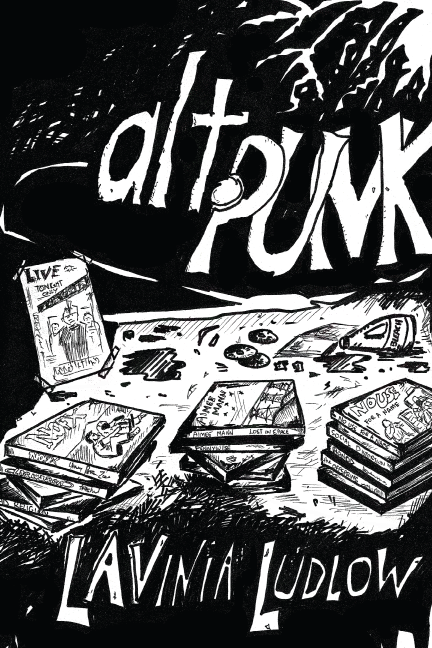
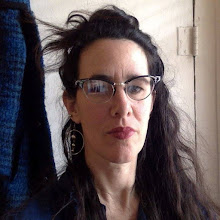
Today's post resumes the Art of the Book Review interview series. Lavinia Ludlow is a prolific small press reviewer and talented fiction writer who made waves with her wry and original debut novel, alt.punk: In it, Ludlow gives us Hazel, an obsessive young neatnik with a weakness for punk boys who keep her busy with their messy lives. Lavinia reviews indie lit titles for publications like American Book Review, The Nervous Breakdown, Small Press Reviews, Smalldoggies Magazine, and Plumb Blog.

Karen the Small Press Librarian: What do you believe a book review should DO? What's its job?

Lavinia Ludlow: Highlight an author’s writing style and content, and help market the book’s major dramatic focus. Many titles release every day in the mainstream and indie market, and a review gives readers a short summary and critical glimpse into the bones of the book.

Karen: Do book reviews matter, and if so, to whom?

Lavinia: All stakeholders involved. Reviews are varying interpretations that can spark discussion points, controversy, and interest. They can also give authors and publishers constructive or blatant feedback.

Karen: It seems like you are doing a great service to small press authors by reviewing so many of their books. Do you view it this way?

Lavinia: I enjoy reading indie titles because I gain a sense of where the industry is heading. I’m also exposed to many different narrative voices, points of view, and content and writing styles I find impossible to find in the mainstream market. Reading indie books/manuscripts is not only enjoyable, but I feel as if I get to connect with writers near and far through their most intimate projects.

Karen: Do you think that small press books get a fair shake in terms of getting reviewed (in terms of both quantity and quality of reviews)? Do you think that reviews are the best way to get the word out about new small press titles?

Lavinia: I definitely think there are great review sites out there that get a lot of foot traffic. Small Press Reviews by Marc Schuster is absolutely stellar. The Nervous Breakdown is another. Pank Mag. Smalldoggies Mag. Just to name a few. I feel it’s definitely harder for small press books to gain publicity merely because not every indie writer/press has the resources to market “big.” However, with enough research and networking, indie authors can definitely get their material reviewed in fair amounts.

Karen: In alt.punk, your protagonist, Hazel, is a very neurotic character: a hypochondriac and extreme germaphobe who hangs around with sloppy-drunk punk boys who live in their own messes. I thought she was a really funny, interesting, original character—an alternative to all the jadedness that is usually associated with rock-and-roll memoirs or punk voices. But Hazel is not necessarily someone who readers are going to be comfortable identifying with (assuming many readers feel pressure to do so). Did you find this issue came up in reviews of your book? Did you find that reviewers were critiquing the character as much as the writing?

Lavinia: Some reviewers did strike down Hazel’s extreme persona, but most characters in alt.punk fell on extreme sides of the spectrum whether liberal, conservative, hypercritical, or just plain bizzaro. I wrote and edited the manuscript when my life was at its most chaotic and unsettled. The intensity in my head matched what I put down on the page, and alt.punk is a reflection of me (at the time) at my most honest. I wholly understand how intense the content and voice narration may seem to some readers.

I did find reviewers analyzed the characters a tad more than my writing style, but this goes back to my intentional attempt at extreme personas. All in all, I accepted the feedback, understood where reviewers were coming from, and have applied the lessons to my forthcoming projects.

And so, full steam ahead.

Karen: Don't get me wrong, I'm not trying to make you defend Hazel, either why you wrote her in the first place, or why you thought she would work in your novel. Instead, I'm wondering: Are we as female novelists actually expected to write fully-functioning feminist heroines for protagonists because of the age in which we're living? And if we respond to our critics by trying to "do better next time," isn't that a potentially problematic tendency to try and be appealing as women all over again, to attempt to soothe the anxieties of others, in writing instead of in life?

Lavinia: I don't think we are, no. I believe if a male author wrote a similar POV with equal codependencies, phobias, and hangups, he would receive similar criticisms on content or story direction. My editor once told me that a writer should craft a scene/scenario and continue to move the plot forward so that the reader is "rooting" for the protagonist. We should want to see him/her succeed, against the odds.

*****

Thanks to Lavinia for her participation in the series. Check out previous interviews about book reviews/reviewing with:

*Djelloul Marbrook (September 10, 2012)
*Lynn Alexander (August 20, 2012)
*Barrett Warner (July 25, 2012)
*Spencer Dew (July 18, 2012)

and a digest:

Book Reviews Debate Rages On (September 11, 2012)

Wednesday, March 6, 2013

Book Launch for Spencer Dew


Congratulations to Spencer Dew and Ampersand Books for the release of Here Is How It Happens, Dew's debut novel. The book launch will take place in Pittsburgh tomorrow night at Awesome Books' downtown location. Awesome Books is the only literary bookstore in Pittsburgh's Cultural District and turned up as a "pop-up" store in December 2011. They've quickly gained a reputation for their savvy selection of new and used books (both classics and new indie lit titles), as well as their regular roster of book events that gather lively crowds of small press writers. Awesome's downtown presence has been a welcome surprise to tourists and Pittsburghers alike, and we hope it stays around for a long time.

I'm honored to be involved in the book launch reading for Dew's novel, along with poet Michael S. Begnal, a Salmon Poetry author and former editor of Galway literary magazine, The Burning Bush.

It was also an honor to be asked to write a blurb for the darkly comic Here Is How It Happens. Here's what I said:
"Spencer Dew writes like a quiet maniac who sees the violence under the façade of everyday things, and the beauty under the violence. With X-ray vision and fine-tuned prose, Dew discovers insights and absurdities in the Americana of box stores, elite colleges, poetry students, buffet restaurants, historic plaques, alternative radio, conspiracy theorists, installation artists, and lug-headed drug experimentalists. Here is How it Happens explores the place where the heartland meets the rust belt meets the precarious bubble of academia, and finds redemption in the purity of longing and the shit coffee of an Amish country diner.”

Order the book from Ampersand Books here:
http://ampersand-books.com/here-is-how-it-happens-by-spencer-dew/

Read the first review of the novel at XenoFiles here:
http://ljmoore.wordpress.com/2013/03/02/here-is-how-it-happens-spencer-dew-ampersand-books-march-2013/


*****

Previously on this blog:

The Next Big Thing Blog Hop: Spencer Dew

The Art of the Book Review: Spencer Dew